
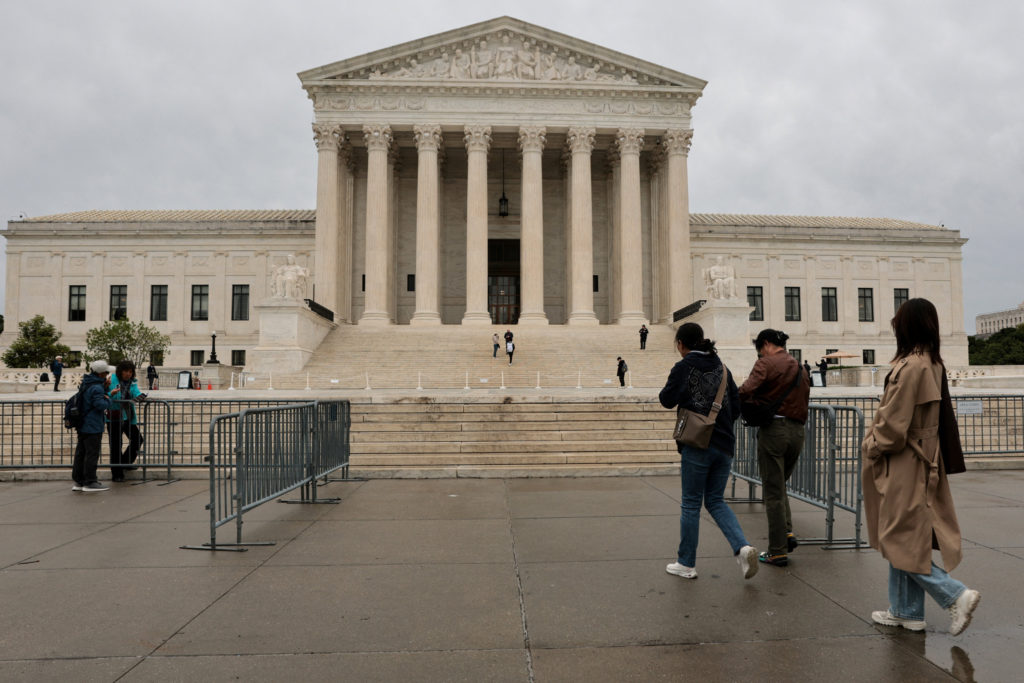
On Tuesday, June 2, 2026, the mid-term elections were drastically influenced by an emergency per curiam order from the Supreme Court. In a 6–3 decision on the Allen v Milligan case that split the high court strictly along ideological lines, the justices granted the state of Alabama permission to resurrect its highly controversial 2023 congressional map. By reverting to the 2023 map, the Court eliminated the second Black-majority opportunity district, which the Court had previously preserved in 2023 to uphold the Voting Rights Act of 1965 (VRA), which had long protected the establishment of opportunity districts. The decision is in effect for the fast-approaching 2026 midterm elections, and the emergency stay has effectively blocked Alabama’s lower court’s injunction that rejected the 2023 map.
Crucially, this order in Milligan stands as a direct extension of the Court’s definitive ruling in Louisiana v. Callais handed down just thirty-four days prior on April 29, 2026. This landmark decision, also nailed down at 6-3, decided that Louisiana’s newly drawn second Black-opportunity district is unconstitutional. The Court found that this map, drawn with race as the dominant factor, was an act of racial gerrymandering; thus, a new standard for interpreting the VRA was established. As of Milligan, the high court had essentially instructed the lower judiciary to apply the newly minted Callais doctrine as a binding precedent.
The immediate consequences on the ground in Alabama are swift and disruptive. By resurrecting the 2023 boundaries, the Court effectively eliminated a hard-fought second Black-majority opportunity district—a seat occupied by Democratic Representative Shomari Figures, which had been established under a court-ordered map for the 2024 elections to rectify vote dilution. Its sudden elimination transforms a competitive 5–2 map into a secure 6–1 Republican stronghold, diluting Democrat as well as Black voting power across the state.
The Court’s decisions in Callais and Milligan resulted in a push for mid-decade redistricting across the American South. Republican-led states including Alabama, Louisiana, and Tennessee had advanced plans to redistrict for the 2026 midterm, and more states look to further redistrict for the 2028 election. In total, this GOP-led push could net around 10 additional U.S. House seats, building an advantage for the GOP significantly stronger than the originally thin-cut division. In response, blue states like California are already exploring mid-decade counter-redistricting strategies to neutralize these losses; among them, Virginia’s redistricting efforts have already been struck down by the Supreme Court.
The Legal Saga of the Contended VRA
To understand the source of contentions, one must trace back to the Callais decision, which fundamentally transformed the 40-year-old Gingles Test established in Thornburg v. Gingles (1986). The Gingles test had long served as the primary litigation framework for Section 2 of the Voting Rights Act (VRA), which prohibits voting practices, procedures, and district maps that discriminate on the basis of race, color, or language minority status; the Act specifically forbids racial dilution via districting. Historically, the Gingles framework analyzed the discriminatory effect of a voting map. If a minority group was large and cohesive enough to form a compact district, and white voters voted sufficiently as a bloc to defeat the minority’s preferred candidates, the state was generally required to create an opportunity district—the majority-minority district—to ensure fair representation.
Writing for the conservative majority in Callais, Justice Samuel Alito dismantled this framework by introducing a steeper qualification. First, through the creation of a partisan pretext shield, illustrative maps submitted by civil rights plaintiffs must now satisfy all of a state legislature’s self-defined political objectives, including maximizing partisan distribution and protecting political incumbents. Second, under the court’s revised polarization analysis, plaintiffs must conclusively prove that racially polarized voting cannot be explained by partisan affiliation. Because race and political alignment are deeply intertwined in the American South—where white voters lean overwhelmingly Republican and Black voters lean reliably Democratic—the Court has established a paradox. State legislatures can now dismantle minority-majority districts under purely partisan-based intentions to disadvantage Democrats rather than Black voters. Under Callais, this standard partisan gerrymandering is treated as perfectly constitutional.
It was this precise doctrine that the Supreme Court harnessed in June when it issued its per curiam stay in Alabama. A three-judge federal district panel had attempted to hold the line by issuing a preliminary injunction against the 2023 map, stating they could not see their way clear to forcing citizens to vote under a system tainted by clear racial animus. In overriding them, the high court rebuked the lower panel for failing to grant the legislature a “presumption of good faith” under the new Callais guidelines. By shifting the VRA’s core requirement from proving discriminatory outcome to proving an almost impossible standard of explicit, un-masked intent, the Court has aligned voting rights with its broader conservative jurisprudence against race-conscious public policy. Civil rights attorneys are left with a hollowed-out statute, as structural data showing a reduction in minority representation is no longer sufficient to prove a violation on its own.
Chaos All-Around: Partisan Echoes, Fractured Elections, and Media Schism
The political battle lines over these combined decisions feature a stark divide between national leaders, state executives, and civil rights advocates. The primary momentum for the multi-state redrawing stems from a public mandate by President Donald Trump. Driven by a strategic imperative to secure the narrow House GOP majority, the executive branch has actively encouraged southern governors to nullify existing court-mandated maps and secure safe partisan seats. State executives have framed the Supreme Court’s actions as an important victory for federalism and state sovereignty. Following Tuesday’s order, Alabama Governor Kay Ivey celebrated the legal validation of state legislative independence, asserting that the ruling confirmed the state’s right to control its own district designs without federal micromanagement.
Conversely, national Democrats and civil rights litigators view the back-to-back rulings as an authoritarian overreach designed to manufacture an unbreakable, artificial Republican House majority. Former Vice President Kamala Harris, and other congressional Democrats, has publicly condemned the decision on Louisiana and the subsequent Alabama intervention as “backdooring racism through politics.” Outside of elected office, civil rights organizations have expressed deep alarm. Deuel Ross, Director of Litigation at the National Association for the Advancement of Colored People (NAACP) Legal Defense Fund, spoke out sharply against Tuesday’s order, arguing that the Court’s decision gives cover to states to deliberately and openly discriminate against Black voters without fear of consequence. Davin Rosborough, Deputy Director of the American Civil Liberties Union’s (ACLU) Voting Rights Project, similarly warned that the ruling delays essential relief for minority communities who have spent years fighting for equal access to the ballot. On May 16, the NAACP, ACLU, and numerous other organizations gathered in Montgomery, AL under the name “All Roads Lead to the South” to demonstrate against the Calais ruling.
This fierce debate is closely mirrored by the sharp divide inside the Supreme Court itself, where the three liberal justices formed a unified front of resistance. The fact that the conservative majority chose to issue a definitive 6–3 order, rather than a narrow 5–4 decision, signals an uncompromising party-line ideological bloc. Justice Sonia Sotomayor authored a sharp, direct dissent, warning that the Court was actively causing “a chaotic election.” Sotomayor strongly admonished the majority for “choos[ing] a pass that disregards both democratic values and the rule of law,” warning the Court is “rewarding Alabama’s gamesmanship and outright defiance of court
The practical consequences of the chaos are evident in the changing electoral processes of several states. In Alabama, the administration of the election has been fractured. While voters in three congressional districts cast their ballots on May 19 under the old district configurations, the electoral apparatus for Districts 1, 2, 6, and 7 was abruptly frozen. Governor Ivey moved the primary election deadline for these four districts to August 11, 2026. In deep-red areas, the sudden shift back to the 2023 map lines has thrown sitting GOP incumbents into unexpected geographic matchups against one another. For Democrats, the elimination of the second opportunity district has fractured the Black electorate across southwest and central Alabama, including historic voting hubs in Birmingham and Selma. This has diluted Democratic fundraising power and forced minority candidates into sudden, resource-draining primary face-offs for the state’s sole remaining safe Democratic seat.
As this political turmoil unfolds on the ground, the public understanding of these events remains heavily divided by a polarized media ecosystem. Left-leaning and reform media outlets, such as MSNBC, Slate, and the Democracy Docket, have framed the decisions as an emergency for American democracy. Their prevailing narrative portrays the rulings as a coordinated assault on minority voting rights, focusing heavily on voter suppression, structural discrimination, and the direct disenfranchisement of Black communities. Conversely, platforms like Fox News offer a starkly different interpretation. Their reporting frames the rulings as an important defense of constitutional colorblindness and a victory against race-based discrimination. This institutional viewpoint presents the decisions as a long-overdue return to orderly constitutional limits, asserting that federal “racial quotas” unconstitutionally force state legislatures to sort citizens by race.
The overarching journalistic takeaway from this redistricting battle is the clear breakdown of the Purcell Principle. Named after the 2006 case Purcell v. Arizona, this doctrine dictates that federal courts should not alter state voting rules close to an election to prevent mass voter confusion and administrative disruption. The Court had previously invoked Purcell Principle in Alabama redistributing disputes in 2023, but now in 2026, the high court’s own mid-cycle interventions have caused unprecedented administrative chaos across the country.
By dropping the Callais decision like a political bomb in late April, followed by the sudden Alabama stay in June, the high court forced multiple states—including Louisiana, Alabama, and Tennessee—to rapidly alter their election dates, shift filing deadlines, and upend active campaigns. In Louisiana, the fallout led to an unprecedented situation where civil rights groups argued that halting an active primary process after early absentee ballots had already been cast was a direct violation of the core purpose of the principle.
Rather than maintaining electoral stability, the Court’s selective application of the doctrine has created a perverse incentive structure. State legislatures are now effectively encouraged to pass highly partisan or discriminatory maps right before deadlines, knowing the high court will likely block any lower-court attempt to fix them before Election Day.