Home Blog Page 1248

From Apathy to Zealousness: Student Political Involvement in the US and China

0

作者:Gretchen Trupp  来源:US-China Perception Monitor

YOUNG PEOPLE IN BOTH THE U.S. AND CHINA REMAIN IN THE SPOTLIGHT OF POLITICS, WHETHER THEY ARE BEING DISCUSSED AS A GROUP, PRAISED, OR CRITICIZED. BUT ARE STUDENTS IN THE US AND CHINA ACTUALLY INVOLVED WITH POLITICS IN THEIR RESPECTIVE COUNTRIES? HAS STUDENT INVOLVEMENT CHANGED HISTORICALLY?

While it is difficult to compare American and Chinese student involvement in politics because of how incredibly different their governments are in terms of structure (communist state vs. constitutional federal republic), how political parties operate (one major party vs. two major parties), and political outlooks (the system as a means to an end and betterment of the country vs. the system as morally just). This article serves as a brief examination of what political participation can look like in each country. It does not attempt to take a specific political stance or comment on how “effective” participation is, but rather seeks to observe party involvement and examples of student engagement with political issues. Involvement in politics can look like many different things, whether that is joining a political organization, contacting a member of the government, and engaging in political dialogue. For a full breakdown of US-China government similarities and differences, please go here and here.

2017 data from the National Bureau of Statistics estimates that there are about 27 million college students in China. And, according to the National Center for Education Studies, there are about 20 million college students in America. The charts below show a historic graph of Communist Party membership of Chinese college students, and a graph comparing the percentages of American voters who are registered with a party by their age. While there are obvious differences in government and party structures, this initial glance shows that students in both countries are at the very least aligning themselves with a set of ideologies adopted by a specific political party.

""""


AMERICAN STUDENTS AND POLITICAL INVOLVEMENT

Studies from Peer Review conducted in 2008 would say yes. US student involvement and engagement in politics has on the rise, with around 64% of students concerned about the future of the country. This continues the historic legacy of US college students raising their voices for political purposes. The 60’s saw a wave of student activism in the wake of events such as the Vietnam War, which furthered student distrust in the government. A new type of Left thinking emerged, driven by issues of civil rights and condemning Cold War mentality that can still be seen in some forms today.

""


This engagement in political matters has only continued to grow since the research in 2008. In recent statistics from the Pew Research Center, “four-in-ten Millennials say the government should be able to prevent people publicly making statements that are offensive to minority groups, while 58% said such speech is OK“. Older generations, on the other hand, are more likely to agree with the aforementioned 58% and “are less likely to favor the government being able to prevent speech of any kind“. This shows a greater concern on the younger generation’s part in how the government regulates speech. Millennials are also slated to be the most educated American generation thus far, and the largest. The Panetta Institute for Public Policy has found that the 2016 election in particular has sparked a greater interest in politics among the younger generation, which could mean a larger voter base.

Being involved with politics does not always mean that students will blindly support the actions of the government, however. In 2015, Americans in general were more distrustful of their government—only 19% say it can be trusted all or most of the time. Students are also more likely to protest on campus now than in previous years, and almost half of these surveyed believe that being a community leader and being civically engaged are important. While there are racial disparities in these statistics (those who are white and Asian are less likely to protest, etc.), there is definitely a notable and important upward trend in political involvement on college campuses around the country. Valuing civic engagement demonstrates that many American college students are engaged with politics at a number of different levels, and that being involved is seen as important and a core value for many.

CHINESE STUDENTS AND POLITICAL INVOLVEMENT

Chinese students have been involved in student activism (both pro-Party and pro-democracy) for many years. Pro-Party recruitment has a large historical precedence, and much of the intense recruitment efforts are directed at college students, who will continue to be involved after they graduate. Some people claim that Chinese students are not really involved in politics because it is boring, dangerous, and not a priority. These aspects have actually not been found to hinder student involvement in politics, since these same characterizations led students to be involved in the past, and are not necessarily currently politically satisfied. Differences in government structure can also account for this perceived lack of political participation in comparison to American politics, as major elections are done by those in high tiers of government and so local people aren’t always involved in consistent political process. But pretty much everyone is focused on personal issues at some level—and the personal is often political.

Chinese students and their personal relationship to their country (whether on economic, social, or political grounds) is an important factor that pushes students to get involved. Students involved in politics in China have historically mobilized forces not confined to a single campus or social group. “Chinese students, in particular, are well-known for acting as the conscience of their nation, and as a force for political change since the early twentieth century“. For example, the Communist Youth League currently has around 88 million members— many of whom are in college. The Youth League has their own official Weibo micro-blogging account, which they use to make political statements. Recently, new restrictions on censored content were handed down by the government, which included depictions of homosexuality in media. Many organizations voiced their dissent, but the Communist Youth League actually spoke out directly against this measure on Weibo, as shown in the picture of their post below:

""


SOCIAL MEDIA AND POLITICS

More and more American millennials are getting their political news from social media, a trend that is occurring in China as well. These various sites and apps such as Facebook and Weibo provide avenues for communication and political involvement, and US students as a whole are more engaged with politics as a result. Research conducted by Xinzhi Zhang and Wan-ying Lin finds that “information exchange uses of SNS and SNS-based political activities were positively associated with the canonical mode of political participation—that is, contacting media and joining petitions and demonstrations. SNS-based political activities also positively predicted political engagement via private contacts, such as lobbying acquaintances of governmental officials, and facilitated political actions initiated by the Chinese Communist Party.” While there are obvious differences in app use, accessibility, and censorship, there are definite similarities that emerge. Many argue that Chinese youth are disinterested in politics, but the research below will confirm otherwise. Additionally, these same arguments are also being made about youth from the US as well. A simple google search leads to hundreds of articles claiming that young American people don’t participate in politics, and statistics claiming that millennial Americans talk about politics less than their older counterparts.

While there has been historic hesitation in discussing political matters for fear of safety, Chinese citizens still hold nuanced views of politics and engage with it on many levels like social media—particularly young Chinese netizens. Some Chinese Students have even shown up to recent protests, provoking a response from the government, urging young students not to head to the front lines in social conflicts. But young school students historically played a major role in the cultural revolution defending Mao and his views. Particularly with the rise of social media, students are playing a big role in shaping digital culture. Access to communication and resources allow creative minds to flourish and students lack many historical barriers to knowledge, such a lack of internet and high rates of illiteracy (although people can still care and be involved in politics and not be literate). Monitoring use of social media sites like Facebook have also shown that there are indeed correlations between political engagement and social media activity.

Despite differences in government structure, style, and engagement of citizens in the political process, both Chinese and American youth participate in politics a variety of forms, with social media often being a venue for action and dialogue. While students from both countries engage in different ways and different levels, there is still involvement with main political parties and online political contributions. Older people in both countries claim a lack of student political involvement, but studies have shown this to be false. Young people represent the political future of both countries, and regardless of outcome students are shaping up to be major influencers.

(FEATURED IMAGE CREDIT: INSIGHT TO DIVERSITY) By GRETCHEN TRUPP JULY. 20, 2017

Gretchen Trupp is a Summer 2017 intern at The Carter Center China Program.

来源时间:2018/4/2   发布时间:2017/7/20

旧文章ID:15641

How China and the U.S. can Collaborate with China to Eradicate Malaria

0

作者:Yawei Liu  来源:US-China Perception Monitor

How can the United States and China cooperate in Africa? A paper recently published in the Centre for Chinese Studies, Stellenbosch University, by Dr. Yawei Liu, Director of the China Program at the Carter Center, and William Pierce, former China Program Graduate Assistant, discuss malaria assistance in Africa.

Solid Foundations for a New Partnership: How China and the United States Can Collaborate with Africa to Eradicate Malaria offers insights on overcoming systematic challenges, broadening diagnosis and treatment availability, and scaling up effective programs, among other topics.

Abstract:

The United States (US) and China prioritize malaria assistance by broadening diagnosis and treatment availability at regional and grassroots levels. Despite complementary elements and direct overlap in their malaria assistance there has been little collaboration between the two countries. Systematic challenges including mutual suspicion, incompatible government structures and hesitancy on the part of Africans contribute to this lack of progress. China and the US can collaborate to broaden diagnosis and treatment availability, distribute insecticide-treated bed nets more effectively, standardize anti-malaria training and share relevant information on behavior change strategies, operational research and monitoring and evaluation. This collaboration can create synergy, producing greater health outcomes and improve the assistance programs, for instance, Chinese Medical Teams (CMTs), the anti-malaria project in the Comoros and anti-malaria centers can especially benefit. Perceptions are changing with leaders such as Liberian President, Ellen Johnson Sirleaf, praising past collaboration and former Tanzanian President, Jakaya Kikwete, welcoming Chinese participation in multi-donor programs. The current policy framework makes Ghana, Kenya, Zimbabwe, Angola and Zambia especially viable for partnership. Greater Chinese participation in multi-donor forms and improved transparency can also facilitate this shift.

来源时间:2018/4/2   发布时间:2017/9/7

旧文章ID:15640

Report on the Great Power and Global Peace Forum

0

作者:  来源:US-China Perception Monitor

On October 24, 2017, The Carter Center and the Halle Institute for Global Learning at Emory University invited Arun K. Singh, former Indian Ambassador to the United States and Henry Levine, former American consult general to Shanghai. to speak on great powers and world peace. Dr. Philip Wainwright, Vice Provost for International and Strategic Initiatives at Emory Unviersity opened the conversation and Dr. Yawei Liu, Director of the China Program at The Carter Center, moderated the dialogue that touched on how India, the U.S. and China interact on the global stage and if three great powers could enter into long lasting collaboration that can anchor world peace and prosperity. Whereas Ambassador Arun K. Singh presented a glowing picture of India’s successful diplomacy, Mr. Levine was much more pessimistic on where the U.S. is going at the present time. Much of the conversation focused on the recent border dispute between India and China and why Secretary of State Rex Tillerson lashed harshly on China during a speech on October 18 when he announced a new partnership with the Indian government.

The conversation ended on the central issue of possible Sino-Indian cooperation because an armed conflict between the two major powers in Asia would certainly upset the balance of power in Asia and interrupt the slow recovery of the world economy. Ambassador Singh expressed his support for BRICS, an emerging economic alliance that are led by China and India and emphasized that China needs to reassure India that its Belt and Road Initiative is not designed to hurt India’s geostrategic interests. Levine said it was unwise for the U.S. to manufacture a new coalition of the willingness to force China to toe in to the so-called international norm. Liu wondered if U.S., China and India could venture into tentative cooperation on peacekeeping operations in African countries.

This conversation seems to suggest it is easy to talk about great powers jointly waging peace in the world but old ideas die hard and it is very difficult for the three powers to come together and come up with realistic solutions that are backed by the resources from all three government.

If you wish to listen to the full recording, you may listen to it here.

来源时间:2018/4/2   发布时间:2018/4/2

旧文章ID:15639

Prospects for Education Reforms in Xi’s New Era

0

作者:Mary Brown Bullock  来源:U.S.-China Perception Monitor

Education is in the DNA of U.S. – China relations, a DNA strand that has served both countries well during the Qing, Republican and Reform and Opening periods. One is reminded of Yung Wing’s first educational mission to the United States in the 1860s, the Boxer Indemnity Scholarships of the early 20th century, and the American colleges of the Republican period.

Today both countries acknowledge the extraordinary contribution educational relations have made to U.S. – China relations. In September of this year, in her key note address to the opening ceremony of the China-U.S. University Presidents and Think Tank Forum, Vice-Premier Mme. Liu Yandong stated:

We hope that universities and think tanks of the two countries will carry out strategic and forward looking research and jointly cultivate high-quality talents so as to make positive suggestions for the development of China-U.S. relations.

Certainly the scope and scale are unprecedented. Today China is America’s largest educational and scientific partner, and vice-versa. All Chinese provinces and autonomous regions have educational agreements with American universities and all but Xinjiang, Tibet and Qinghai have joint degree programs. One hundred and thirty-three American universities from more than 40 states offer educational programs in China. The United States is the #1 destination for Chinese students – this fall number 328,000, forty one percent of whom are undergraduates.

These remarks are drawn from a talk given at Hong Kong University in fall 2016 and from an article published in the last issue of China Currents. Although the numbers are far fewer China is the #1 developing country destination for American students. Most of the American Ivy League schools are sponsoring stand-alone research centers in China while three American universities – NYU, Duke and Kean – have established comprehensive joint venture independent Chinese universities. The Schwarzman College, a fully American funded graduate school opened at Tsinghua University last year.

Two characteristics are especially relevant to the bilateral relationship: the dominant role of the sciences and the far lesser role of the social sciences and humanities. An authoritative study has concluded and I quote: “Measured by co-authored scientific research papers, U.S. collaboration now exceeds collaboration with traditional partners such as the United Kingdom, Germany and Japan. China and the United States have become each other’s main partner in scientific collaboration.” The social sciences and humanities are far less visible. Only 7% of Chinese students in the U.S. are in these fields. During the last three decades American scholars have learned a great deal about China, historically and today. Information about Chinese history, economy and government has been passed onto American the broader public. The Chinese study of the United States has, however, been rather limited. I want to draw attention to the fact that more accurate high school and college textbooks are needed. It may be time for a joint scholarly review of how the textbooks of each country portray the other.

As the Xi Jinping era continues it is clear that a new paradigm has emerged. First, the educational relationship is no longer asymmetrical; it has become symmetrical. Gone are the days when China needed American educational assistance. China’s universities have experienced unprecedented growth, including massive funds for infrastructure and research. China is creating world-class universities and Chinese funds are building and sustaining the new joint venture universities and collaborative programs in China. No longer do American universities provide free rides for under privileged Chinese students. They are now seeking self-paying Chinese students. In 2015 these contributed $9.8 billion to the American economy.

Second, for the first time China is directly participating in research and education in America. In 2015 Tsinghua University, the University of Washington, and Microsoft announced the creation of a new research and education institution in Seattle, the first such bilateral venture in the United States. Ten years earlier the Chinese government-funded agency, Hanban, began funding Confucius Institutes in American universities. Today there are over 100. Most have flourished but some have appeared to have an overt political agenda. Also there have been recent reports of external efforts to shape the political views of Chinese students attending American institutions.

This relates to the third change which is ideological. In 2014 the Minister of Education called for a rejection of western learning and subsequent government documents have reinforced the importance of Marxist ideology and the exclusion of western values. Last month a new MOE directive called for party secretaries to be given vice-chancellor status and a decision-making role on the board of trustees of joint venture institutions, quite different from the previously approved independent board of trustees’ structure. From my experience as executive vice-chancellor of Duke Kunshan University I know that the shared governance model, which includes but does not privilege party members, worked very well – for both countries and sponsoring institutions.

Taken together these three factors – the advent of world class Chinese universities, the entry of China into the domestic American educational world, and China’s current ideological campaign – point to a more complex and potentially contentious future. The core value of American universities – and indeed a core interest of the United States government – is academic freedom. In response to a request from the U.S. Congress in 2016 the United States Government Accountability Office issued a report on academic freedom in American educational programs in Chinas titled “U.S. Universities in China Emphasize Academic Freedom but Face Internet Censorship and Other Challenges.” Based on surveys and interviews conducted in 2015 the report concluded that most programs experienced no ideological interference but were frequently hamstrung by internet issues. If China’s universities and scientific institutions wish to continue their global collaboration open and unfettered communication is essential.

Let me conclude on an optimistic note. The U.S. – China educational relationship has survived earlier periods in which China has questioned western values. China’s quest to form a distinctly Chinese modern education system is central to its modern history. We need to learn more about this emerging model which draws on Confucian and socialist values as well as the western research and liberal arts model. And I believe we share more values than some realize. When I spoke of educational values at Duke Kunshan I always talked about a cluster of values: academic freedom, academic responsibility and academic integrity: Chinese educators understand that all of these values are central to a vibrant and innovative university community. I am confident that education will continue to play a positive, ever more strategic role, in U.S. – China relations.

来源时间:2018/4/2   发布时间:2017/12/15

旧文章ID:15638

Can the First North Korean Nuclear Crisis Inform the Current Challenge

0

作者:Marion V. Creekmore, Jr.  来源:US-China Perception Monitor

(Presentation at The Sixth TCC-CPAFFC Forum on US-China Relations by Marion V. Creekmore, Jr.)

Unlike the other panel members and most of the conference attendees, I am not an expert on China, the Korean Peninsula, or Northeast Asia.  I am speaking because I accompanied former US President Jimmy Carter to North Korea in 1994 where he achieved a negotiating breakthrough that led to a peaceful resolution of the first North Korean nuclear crisis.

I think there are lessons from the first North Korean nuclear crisis that could be useful in dealing with today’s challenge.  Let’s review what happened.

The situation in 1994 was quite different from that of today.  North Korea did not then have any nuclear weapons.  Its missile program was not a threat.  Yet the world found itself in a crisis that threatened to spiral into a second Korean War.

The secret Pentagon assessment at the time: if fighting commenced, the human cost would be 52,000 US casualties, 490,000 South Korean casualties, and many more North Korean casualties; the financial cost for the first 90 days: $61 billion in 1994 dollars, or $147 billion in today’s dollars.

At that time North Korea had a 5MWe, graphite-moderated nuclear reactor that was operational and two larger ones under construction.  It also possessed a reprocessing facility that could produce plutonium from the spent fuel rods used in the nuclear reactor.

When North Korea placed its nuclear facilities under IAEA safeguards in 1992, it admitted that it had earlier reprocessed a small amount of plutonium—90 grams.    The IAEA suspected that the amount was larger and demanded special inspections, which North Korea refused.

In 1994 the IAEA adopted a tough resolution against North Korea for refusing to allow the intensive inspections the agency demanded.  It threw the issue to the UNSC for enforcement.  The US led an international effort to get the Security Council to adopt rigorous economic sanctions against North Korea.

North Korea threatened to interpret sanctions as a declaration of war.  Its military leaders at the DMZ told their South Korean counterparts that Seoul would be turned into a “sea of fire” if war broke out.  They also warned the American military officials there that the U.S. would not be allowed to beef up its military force in and around the Korean Peninsula as it had done before launching Desert Storm against Saddam Hussein in 1991.

The US Defense Department prepared for President Clinton a set of options for increasing US military strength in and around the Korean Peninsula.  It ruled out the use of “surgical strikes,” fearing that North Korea would retaliate with a massive attack on South Korea.

In May, North Korea began removing the spent fuel rods from its 5MWe reactor.  Reprocessing those fuel rods would produce enough plutonium to make 5-6 nuclear bombs.

That is when former US President Jimmy Carter became personally involved.

His own analysis and those of his domestic and foreign contacts convinced him that UNSC sanctions might indeed cause North Korea to retaliate militarily.  He learned that the US ambassador and the commander of US forces in South Korea shared his concerns.

Carter believed strongly that war should not be risked before someone talked with Kim Il Sung, the North Korean president, who would decide whether his country would go to war over the nuclear weapons issue.  Moreover, he thought Kim Il Sung wanted a diplomatic solution to the crisis.

Carter found it disturbing that the Clinton administration ruled out sending a top official to talk with the North Korean president.  It feared hardline critics would accuse it of giving international legitimacy to a rogue state.

Previously, Carter had been invited twice to visit North Korea.  He had been promised a meeting with Kim Il Sung if he accepted.

The former president finally concluded that he would go, believing correctly that his former status as president would cause the North Koreans to treat him as a high-level interlocutor.

In the end, President Clinton endorsed Carter’s travels, but not as an official emissary.  The formal press announcement characterized Carter as a “private citizen representing The Carter Center.”

Carter rigorously prepared for the trip.  He put greater credence in the views of those who had been to North Korea and met Kim Il Sung than in those who interpreted internal North Korean developments by reading the tea leaves from abroad.

A case in point: Most Washington officials believed that the real decision-maker in North Korea in 1994 was not Kim Il Sung but rather his son, Kim Jong Il.  The son may well have been making day-to-day operational decisions.  But as Carter suspected, Kim Il Sung retained final authority over the nuclear weapons program and questions of war and peace.

Carter considered his first task to be establishing a personal relationship with Kim Il Sung.  In their direct conversations and in his discussions with subordinate officials, Carter consciously avoided language that might seem to threaten North Korea’s national existence and social cohesion.


He discussed policy differences as problems that friends could resolve by working together for mutually beneficial results.

Carter would learn that Kim Il Sung’s subordinates would argue every point in a bombastic manner, pretend victimhood, and often make outrageous demands.

In the first afternoon of substantive discussions, the North Korean Foreign Minister gave a masterful performance of the “bad cop;” he was demanding and unyielding.  Carter coolly explained why peaceful resolution served North Korea’s interest as well as that of the U.S. and others.

The next day, when Carter first met with President Kim Il Sung, he received a very different reception.  The North Korean leader, known to his country’s citizens as the “Great Leader,” was gracious, respectful, and desirous of a mutually beneficial resolution of the differences between his country and the U.S.

Kim Il Sung agreed to:

  • keep the IAEA inspectors in place—they had been ordered to leave a couple of days earlier;
  • freeze all aspects of North Korea’s nuclear program until a third round of US-North Korean technical talks could be held; and
  • replace North Korea’s proliferation-prone nuclear reactors with safer light water reactors, provided financing was provided by others.


These positions were consistent with the US views, which had been explained to Carter in advance of his trip.

Carter told Kim Il Sung that he would report their conversation to Washington and recommend that the Clinton administration approve the points on which he and the North Korean president had agreed.

This session was followed by a long afternoon of talks with Kim Il Sung’s subordinates responsible for nuclear issues.  They repeatedly tried to walk back the concessions Kim Il Sung had made, but on each occasion Carter listened patiently and then asked them why they were arguing for views different from those of their “Great Leader.”

That quickly led to denials and breathtaking, 180-degree turns by the North Korean officials who affirmed that the Great Leader’s decisions were irreversible and would be fully carried out.

That evening Carter was interviewed by CNN.  He explained his agreements with Kim Il Sung and his intention to recommend that Washington and Pyongyang officially engage in a new round of negotiations to resolve the nuclear crisis.

Carter held the news conference for two reasons.  The most important was to lock in publicly Kim Il Sung’s positions to stop his subordinates from continuing their efforts to modify their president’s concessions.  The second aimed at Washington—to ensure that the Clinton administration would deal with Kim Il Sung’s actual positions, not some reinterpretation of them that might emerge in subsequent policy discussions.

Taking advantage of the Carter-Kim Il Sung breakthrough, the Clinton administration negotiated with North Korea the so-called Agreed Framework that both governments signed four months later.  It froze the North Korean plutonium-based weapons program for eight years.  The Clinton administration considered resolution of this first North Korean crisis as one of its major foreign policy successes.

The George W. Bush administration, after the September 11, 2001 tragedy, took a tougher approach toward North Korea.  During the late 1990s, North Korea began surreptitiously developing a uranium enrichment facility as a different way to produce nuclear weapons, and the Bush administration confronted Pyongyang on this violation of the Agreed Framework.  North Korea blamed the US and its allies for not having met some of their obligations under the Agreed Framework, which was also correct.

The agreement collapsed in December 2002.  Less than four years later, North Korea tested its first nuclear weapon.  Belatedly, the Bush administration restarted bilateral negotiations in the context of multilateral talks without significant achievements.  The Obama administration rejected the negotiation route altogether and relied on military superiority, deterrence, and repeated rounds of UN sanctions to deal with the North Korean nuclear weapons and missile issues.

Lessons from the First Crisis to Deal with the Current One:

That brings us to the present.  The United States and its allies appear to be focusing on three, non-exclusive approaches for dealing the current nuclear crisis—a preemptive military strike, strengthened deterrence, and consultations with China, North Korea’s most important trading partner.

Most serious experts reject a preemptive military strike because North Korea would likely respond with a major attack on South Korea and perhaps Japan.

Deterrence is currently being strengthened with joint military exercises and deploying missile defense systems to South Korea and Japan.

China and the US are engaged in intensive consultations about North Korean actions.  Both have stated that they support a denuclearized Korean Peninsula.  They have cooperated in the UN Security Council on imposing economic sanctions on North Korea although their calculations seem to differ about the level of economic pressure to which North Korea should be subjected.

I presume Washington and Beijing are also engaging in a strategic dialogue about regional peace and security.  They share converging strategic interests in ensuring 1) that war is avoided on the Korean Peninsula, 2) that other countries in the region do not develop nuclear weapons, and 3) that they will need to cooperate rather than compete in securing North Korea’s nuclear weapons should its ruling regime weaken significantly or collapse in the future.

A new approach should be added: The United States should make a serious and sustained effort to initiate high-level, bilateral negotiations with North Korea.  The US should offer to open negotiations with Pyongyang without conditions—as Carter did in 1994.

The initial purpose of these talks should be to clarify the vital interests of both sides and determine if a course of negotiations could be constructed that would potentially be beneficial to both sides.

Since North Korea believes its nuclear weapons and missiles are the best guarantee for the security of the country and its ruling regime, it would be a non-starter for the US to insist that North Korea pledge in advance to give up its nuclear weapons and missiles.

But Pyongyang has other goals as well—to be treated as a normal member of the international community, to gain economic assistance for its struggling economy, to reach a final settlement and peace treaty for the 1950-1953 Korean War, to discourage US-South Korean and US-Japanese military exercises directed against them, and to see the US military presence in South Korea and perhaps Japan reduced.

The overarching goal of the US, its allies, and other countries should continue to be a denuclearized Korean Peninsula.  But that result must be viewed as the end-point, not the beginning, of a long-term negotiating scenario with North Korea.

At this time the first-priority should be to get the North Koreans to freeze their testing of nuclear weapons and the missiles to transport them.  Their testing is the biggest source of the current crisis.

The US and its allies would have to offer North Korea something that it would regard as equally beneficial.  What that could be would have to be determined through good-faith bilateral negotiations in close consultations with our allies.

The negotiations should be initiated by a senior administration official, such as the Secretary of State, or a highly respected outside dignitary with close ties to the Trump administration.  That person should consult directly with President Kim Jong Un. I think the first meeting should take place in Pongyang.

The main purpose of this initial meeting should be to establish a personal relationship with the North Korean leader and discuss how together the two countries could begin through regular negotiations to resolve the problems preventing improved relations.

Ideally, these two persons should announce publicly the early commencement of formal bilateral negotiations and state their intention to follow the progress of their respective negotiators and consult as necessary when hurtles in the negotiations arise.  This would provide a means for higher-level involvement if negotiators become deadlocked.

Let me close with this: Negotiations may not work, but they should be tried.  It is at least as important to talk with your potential foes as with your friends.  Direct communication can reduce the possibilities of misunderstandings and misinterpretations that lead to misguided actions.  War should always be the last resort; it should not be stumbled into.  And, on occasion, as in 1994, negotiations can be productive.

来源时间:2018/4/2   发布时间:2018/1/23

旧文章ID:15637

Participants Debate the Arrival of a Tipping Point at 2018 Young Scholars Forum

0

作者:Vincent Palumbo-Smith  来源:US-China Perception Monitor

The U.S.-China Young Scholars Forum (YSF), initiated by the Carter Center and The Global Times since 2014, took place this year on January 30-31. On Tuesday, January 30, young Chinese and American scholars presented their research in panel presentations. In the round table discussion on the second day of the YSF, five well-known Chinese and American opinion makers discussed the potential impact of the 2018 U.S. National Security Strategy (NSS) on the most consequential relationship in the 21st century and what can be done to reduce misperception and hostility between Washington and Beijing.

Unveiled by the Trump administration last December, the 2018 NSS is significant for the way it refocuses American foreign policy objectives away from combating global terrorism to “great power struggle” with the “revisionist powers” (China and Russia). In the document, the Trump administration argues that reprioritizing American national security interests is warranted because China is increasingly applying its power and wealth to advance a geopolitical agenda conducive to the preservation of its one-party system and elevate its position on the world stage. Overall, the 2018 NSS frames China as a rival to U.S. national security interests, and that the U.S. should prepare for economic, geopolitical, and even military conflict with China. The question that Robert Kapp, moderator of the round table panel and senior advisor to the China Program of The Carter Center, posed to the panel of Chinese and American experts was simple: Is this shift in the U.S. foreign policy as bad as it looks for the future of the U.S.-China relationship?

PANELIST’S REMARKS

Both panelists representing the Chinese media were concerned by the rising anti-China attitudes within the U.S public and expert community. Ding Gang, editor of the Global Times English edition, worried how his counterparts in the American media conflate China’s rise into a threat. Hu Xijin, the chief editor of The Global Times, directly answered Kapp’s question by stating that the change in U.S. strategy makes conflict with the U.S. more likely. Hu also provided interesting insights about the Chinese perspective, noting that China has altered its historical conception of its central place within the world (i.e. “middle kingdom”) and embraced the reality of a world system that is increasingly multipolar. He implied that it is time for the U.S. to follow China’s acceptance of the multipolar system and set aside its anxiety regarding China supplanting the U.S. as the sole superpower. Hu also explained how the ways ancient China related to its neighbors continues to influence the Chinese view. According to a common interpretation of Chinese history, even when China was at the pinnacle of its influence, China did not seek to dominate other countries by force because Chinese emperors understood that Chinese strength was based on peace with its neighbors. Similarly, modern China does not seek to start conflicts with other countries, because its leaders know that such ambitions would jeopardize its “peaceful rise” strategy.

Zhu Feng, Executive Director of the China Center for Collaborative Studies of the South China Sea, agreed with Hu Xijin and Ding Gang that the 2018 U.S. NSS is concerning, but added that U.S. apprehension about a rising China is also irrational. He emphasized the U.S. is a mature power, while China is only a transformative power. Given the enormity of the power disparities between the two countries, U.S. anxiety is not based on a rational assessment of China’s current intentions and capabilities to subvert American security interests, but derived from the fear of what it might one day be able to do. Zhu acknowledged that this rivalry also extends into the economic sphere. But competition in the commercial, trade, and financial realms is far less concerning because it promotes rather than undermines the prosperity that is necessary to maintain a stable bilateral relationship.

Xin Qiang, an associate professor of international relations at Fudan University, departed from the consensus opinion of his Chinese colleagues by asserting that the 2018 U.S. NSS may not be as important as most people think. He noted that there is often a mismatch between the rhetoric and actions of the U.S government. Generally, a country should judge another country based on its actions and not empty rhetoric that is often directed at a certain political constituency. Under this premise, Xin believes that 2018 U.S. NSS alone is not an insurmountable obstacle to strengthening mutual understanding between the two countries. If the U.S. responds to a rising China with the containment strategies described in the U.S. NSS, then the U.S. may create a clear enemy, but for now we can advert that future if U.S. continues to engage with China on a set of shared national interests.

Robert Daly, Director of the Kissinger Institute on China and the United States at the Wilson Center, was blunter in his commentary than any of the Chinese contributors. As the U.S. moves forward from the anti-China attitudes that produced this year’s NSS, strategic thinkers should not operate under the illusion that the U.S. and China will become true partners. American experts on China also cannot let the fact that we engage blind us to the fact that China is increasingly assertive and repressive. Daly therefore embraces the foundational premise of the NSS that the notion that political liberalization will follow the opening up of its economy is a fallacy. Instead, both countries should come to terms with the reality that they are long-term strategic rivals.

Unlike the 2018 NSS and the companion document released by the DoD, the National Defense Strategy (NDS), Daly argues that rivalry should not be confused with zero-sum fights for dominance. It is possible to navigate the tremendous differences in the way Chinese and Americans see the world, while maintaining a close relationship. The key to walking this tightrope is to not connote too much judgement against the Chinese, Daly argued. After all, all countries with power and wealth use these resources to make the global environment conducive to its national security interests. China is by no means exceptional in this regard. Another problem with the 2018 NSS in Daly’s view is that it does not appreciate that Chinese influence in other country’s economic, political, and social institutions falls along a spectrum from “organic” (innocuous) to “government-directed” (potentially harmful).

David Firestein, the Executive Director of UT Austin’s China Public Policy Center, also agreed with the framework of the 2018 U.S. NSS that the U.S. and China are rivals and that this is unlikely to change any time soon. However, he rejects the stronger language found in this year’s summary of the NDS that China not only “seeks Into-Pacific regional hegemony…[but also] the displacement of the United States to achieve global preeminence in the future.” China’s actual intentions are far closer to what Hu Xijin described in his remarks. China simply seeks to enter into a multipolar world and gradually make itself more equal to the other poles. The misassessment of Chinese foreign policy objectives reflects a psychological phenomenon that Firestein refers to as the two-fold inconvenient truth, where each side regards the other as a fundamental threat to the preservation of its political system and/or way of life.

Without even realizing it, Trump’s statements on China in his State of the Union speech were a product of this two-fold inconvenient truth, Firestein implied. On January 30, President Trump declared that, “We face rogue regimes, terrorist groups, and rivals like China and Russia that challenge our interests, our economy, and our way of life.” Not only does he fail to make a distinction between China and Russia, Trump also lumps these so-called revisionist powers with Iran, North Korea, and terrorist groups. While these actors are all security threats to the U.S., Firestein noted that only China and Russia were mentioned explicitly because they are the nations with nuclear arsenals sufficient to annihilate the U.S. The challenge for U.S.-China relations is how both sides avoid impulses driven by fear and rationally assess the intentions and capabilities of each side.

""

The participants of the 4th Annual YSF roundtable discussion: (from left to right) Zhu Feng, David Firestein, Hu Xijin, Robert Daly, and Ding Gang.

DISCUSSION WITH AUDIENCE

In the discussion portion of the roundtable panel between Firestein, Daly, Kapp, and the audience, a few important insights emerged:

  1. The Cold War doctrine of mutually assured destruction (MAD) ensures that the Thucydides Trap, or that a rising power is destined to collide with an established power, is a myth. However, so long as both China and the U.S. have a dominant strategy to distrust the other side, the equilibrium outcome is mutually assured misperception. Of course, this outcome is not as bad as nuclear annihilation, but it is still suboptimal.
  2. On trade, the Trump administration has been more in line with the policies of previous administrations than is widely appreciated, especially within the context of campaign rhetoric that was historically protectionist. However, the Trump administration has also issued strong signals, including the recent USTR report, to the Chinese government that the trade relationship as practiced in the last two decades is not politically sustainable. Other signals include the Trump administration’s rejection of corporate mergers and acquisitions by foreign entities on broad national security grounds, as well as efforts in Congress to expand this executive power. In September 2017, the Trump administration issued an orderrejecting the acquisition of Lattice Semiconductor Corporation by China Venture Capital Fund (CVCF), a Chinese corporation owned by Chinese state-owned entities. Each one of these signals may indicate that a break from orthodox U.S. trade policy may be coming sooner rather than later.
  3. Regarding Chinese influence in Latin America and Africa, the panelists referred back to their remarks on the importance of exercising cautious judgements of the use of Chinese power in these regions. They emphasized that China is not necessarily going to far corners of the globe because it wants to capitalize on the opportunity to become a neocolonial power. Such a strategy is not productive because many places where China is active were dominated by European colonists in the 19th and 20th centuries and are therefore deeply skeptical of foreign powers. As a result, leaders of these nations will want assurances from the Chinese government and state-owned enterprises (SOE’s) that they have something to provide for the local population, such as employment, infrastructure, or educational and health services. China’s interest in overlooked regions of the world is not to dominate countries and leverage them in global institutions, but a practical response to its late emergence onto the world stage.
  4. Finally, the main challenges China will likely pose to the U.S. in the next couple decades are not necessarily the direct challenges that are generally the most concerning to American foreign policy wonks. As noted previously, China and U.S. are unlikely to collide militarily (see point #1), but they will almost certainly collide ideologically. One current blow to American soft power throughout the world is that its political system is often so paralyzed by hyperpolarization and interest group politics that it cannot even enact its immediate policy priorities. By contrast, China’s one-party system is capable of long-term planning that the U.S. can only dream of. The moderator, Robert Kapp, added the qualification that China was only capable of effective long-term planning after the Reform and Open-Up period in 1978. Kapp’s comment implies that China’s success depends just as much on regular contact with the West as on the initiative and ingenuity of its people.

THE ARRIVAL OF A TIPPING POINT?

Three years ago, David Lampton, Director SAIS-China at John Hopkins University, delivered his “tipping point” speech at The Carter Center that is now widely regarded as prophetic. In that speech, he noted that nobody in either China or the U.S. regarded the other side as the enemy until very recently. China was content with “living with the hegemon” while it developed its economy. On the other side of the Pacific, the U.S. devoted nearly all its national security efforts and resources to combating global terrorism. After U.S. normalized relations with China in 1979 until about 2010, the hope that a robust bilateral relationship would bring prosperity and security was at least as great as the fear that one country might defect from the relationship, generating harms that would reverberate throughout the world. Critically, Lampton did not characterize the relationship as it had been practiced in that period by unbridled hope. Fear has always been a part of the equation. What makes our current situation different from the past is that fear is beginning to dominate over hope, he argued. This dynamic does not guarantee that a tipping point—where relations have deteriorated to such an extent that they are beyond either nation’s ability to repair—will occur. However, every year we ignore the strains in the relationship, the closer we get to the tipping point Lampton warned about.


Nearly all participants agreed with Lampton’s notion that fear is the mechanism that will bring about a tipping point. Firestein referred to the two-fold inconvenient truth, where each side has unsubstantiated fears that the other seeks to undermine the other countries’ way of life. Likewise, Zhu Feng implied that hawkish elements of the U.S. foreign policy establishment are operating under irrational assumptions about the future capabilities of the Chinese military, worsening relations between the two countries. Other participants noted the ways fear influenced the 2018 U.S. NSS in a few specific areas. From “sharp power” to expanding economic presence in Africa, the U.S. NSS often conflates normal activities into threats to American primacy. In addition, all participants agreed with Lampton’s assessment of what is at stake. If tensions are left unaddressed, “both countries will have progressively less security, at higher cost…the world will enjoy less cooperation on transnational issues…and, economic welfare in both societies will be diminished.” Put in another way, a peaceful and prosperous world depends on a healthy relationship between the U.S. and China.

Yet the views of the participants diverged on many hot button issues, from trade to regional security. In general, many Chinese opinion makers do not consider the perspective of the American side when it defends itself against specific allegations, and vice versa. American allegations of Chinese aggression in the South China Sea and the Taiwan Strait demonstrate this phenomenon. Robert Daly represents the American position well by stating that Chinese territorial claims, which include Taiwan, cannot be reconciled with American commitments to its allies in the region. Rather than directly addressing the issue at hand, the Chinese tend to respond with a theoretical concept, peaceful rise, that does little to assuage American concerns. During the roundtable discussion, the peaceful rise argument was best summarized by Hu Xijin who echoed President Xi’s remark to former Secretary of State John Kerry, “The broad Pacific Ocean is vast enough to embrace both the U.S. and China.”

The gaps between the two sides are often just as wide on trade policy. In their rhetoric, President Xi and other CCP elite often fail to recognize the hypocrisy of embracing the virtues of free markets while propping up their domestic industries with subsidies to protect against foreign competition. Like President Xi, Zhu Feng’s embrace of the orthodox economic principle that competition across nations always maximizes overall prosperity did not acknowledge that China often engages in anticompetitive trade practices. Firestein expressed American frustrations when he stated that China has not been nearly as equitable in trade access and intellectual property protections as the U.S. While he explicitly rejected the recent US Trade Representative (USTR) report’s conclusion that supporting China’s ascension to the WTO was a mistake, he implicitly endorsed the Trump administration’s efforts to signal that the trade relationship is unsustainable. Some these signals can be found in the specific complaints of the USTR report, which alleges that the China has expanded rather than lifted the state’s role in the economy over the last five years.

These trade issues are serious, but China should not be blamed for them either, Firestein and Daly clarified. As noted by a recent article in The New York Times Magazinenearly all developed countries pursued protectionist policies until their industries no longer needed them to compete. At which point, these nations, including Britain and the U.S., preached the gospel of free trade. In Asia, the European powers often went one step further and compelled their colonies to accept free trade at the barrel of the gun. This historical context demonstrates that China is merely acting as other rising countries act when they try to advance their economic and geopolitical interests. Blaming China for mercantilist policies the U.S. practiced more than a century ago would be unwise and hypocritical. Refraining from blame is also in U.S.’s best interests because blame sows distrust and hostility. The goal of managing American and Chinese ambitions in the international system becomes much easier if blame does not detract from leader’s ability to clearly see what is at stake.

The final way in which Americans and Chinese differ is on the issue of engagement. Chinese leaders intuitively understand that the engagement of the last 40 years has helped China become the dynamic power that it is today. By contrast, there are many hawks in the U.S. foreign policy community, including the authors of the U.S. NSS, who are openly questioning whether engagement with a rival like China coincides with American national security interests. The reason why these Americans are rethinking their positions on engagement with China is that they are noticing that engagement is not the magic bullet that will make China more like the U.S. As silly as it may sound to Chinese readers, this assumption, known as integration theory, was widespread within the China field. In some respects, Firestein and Daly agree with these hawks that integration theory is a fallacy and that there is a need for a new paradigm describing how the U.S. should conduct its engagement with China. Unlike the hawks in the Trump administration who are suggesting that the U.S. should scale back its engagement with China, Firestein and Daly state the obvious—future peace and prosperity are dependent on a strong bilateral relationship. Engagement is too important to abandon, even if the America and China will never have interests that coincide. Sustained engagement may even be more important in a world where the two greatest economic and military powers are likely to remain strategic rivals for the foreseeable future.

CONCLUSION

The fact that even basic precepts, such as engagement is the foundation of U.S.-China relations, are being challenged is an eerie harbinger for what is likely to come in the relationship. Nonetheless, the panelists did not let the gloomy state of the relationship deter their hope that a catastrophic tipping point can be averted. In the end, the U.S. national strategy documents are just words. They only matter to the extent that they reflect the views of American foreign policy makers who have the power to translate and implement these ideas into concrete policies.

Yet the emergence of China as an incipient superpower is clearly a tipping point in its own right. Just 15 years ago, China was almost entirely focused on using its domestic resources to improve the standard of living its people. Even in its backyard in East Asia, the Chinese government was perfectly content to “live with the hegemon”, as Lampton noted in his speech. While the CCP’s goal is still to improve the standard of living of the Chinese people, China suddenly has ambitions outside of its borders. These ambitions present a challenge that will require American leaders to see past political pressures to get “tough on China” and instead adopt the policy that is best for the long-term prosperity and security of both countries.

In my view, we should look to President Carter for wisdom on how to navigate nationalist impulses to realize common interests for the people of both countries.  After all, he was the U.S. president that normalized relations with China that ushered in an era of unprecedented exchange and prosperity across the Pacific. But the way President Carter approached the other signature achievement of his presidency, the Camp David Accords, is arguably even more relevant to the current challenges facing U.S.-China relations. The climax of those negotiations occurred when the Israeli Prime Minister received pressures from hardliners in his party to leave Camp David and scrap the negotiations. With characteristic calmness, Carter responded bywriting handwritten notes on photographs of the three leaders to each one of Prime Minister Begin’s eight grandchildren. When Begin read these notes, he realized that the point of the peace negotiations was not to select the strategy that would offer the least resistance for his ability to govern in the present, but to offer to all people of the Middle East, including his own grandchildren, the possibility of a long-lasting peace. Chinese and American leaders concerned by the recent turn in the relationship should ask themselves the same question that President Carter posed to Prime Minister Begin in 1978: Do we feel comfortable leaving this world to our children and grandchildren?

""

President Carter’s actions at the Camp David Accords to bring the leaders of Israel and Egypt together offers insight on how China and U.S. should conduct their future relations, recognizing that peace, stability, and prosperity are goals that are more important than the differences that exist between the two countries.


The following summary was prepared by Vincent Palumbo-Smith, an intern at the Carter Center’s China Program for Spring 2018.

来源时间:2018/4/2   发布时间:2018/4/2

旧文章ID:15636

Do Confucius Institutes Pose a Threat to American Campuses

0

作者:Sydney Chan  来源:US-China Perception Monitor

The first Confucius Institute (CI) opened in Seoul, South Korea in 2004, and the first CI in the US opened at the University of Maryland later that same year. The program pairs foreign universities with Chinese universities to offer Chinese language and culture courses at foreign universities. In the US, many domestic faculty and scholars have supported the programs because it allows universities to expand their offerings of courses on Chinese language and culture. Partnership with Chinese universities for a CI allows American institutions to avoid a “low-equilibrium trap” situation in which language programs don’t have the resources to expand course offerings. CIs allow students to learn from experienced faculty from the partner Chinese university and gain exposure to more current ideas and teaching methods. However, transparencies must be made about the nature of these CIs in order to better understand the controversy surrounding their operations.

""

Li Changchun (center) and Liu Yandong (right) at the Confucius Institute Headquarters

The CI program is a global soft power program that is overseen by Hanban, a branch of the Chinese Ministry of Education and part of the Chinese government, that began in 2004. In November 2011, then-Politburo Standing Committee member (retired as of 2013) Li Changchun said that the “Confucius Institute has not only been a significant move in the field of education… but is also an important achievement in culture going global and pays an important role in the improvement of cultural soft power,” during an inspection of the Confucius Institute Headquarters with then-State Councilor (Vice Premier since March 2013) Liu Yandong.

""

His Holiness the Dalai Lama (center)

Due to concerns over CIs connections with the Chinese government, some individual institutes have been the center of controversy in the US. In 2009, North Carolina State University canceled an event to which His Holiness the Dalai Lama had been extended an invitation. Allegedly, the CI at the university raised its objections with the university, though how much impact this would have had on the final decision of the university is unknown. In 2011, an instructor at McMaster University in Canada quit her position due to the conflict between her job and her practice of Falun Gong. Following the incident, the university closed its CI in 2013 because the hiring practices of the CI did not reflect the university’s practices. While the incident took place in Canada, the US has hiring practices similar to Canada.

There has also been documentation of self-censorship within the CI at the University of Chicago, in which an administrator acknowledged his unwillingness to put up a picture of His Holiness the Dalai Lama. In 2014, the university decided not to renew the contract for its CI as a result of the reported self-censorship and a faculty petition. While these incidents have been isolated in the past, concerns regarding the broader program have surfaced in the US government recently.

""

Feb 13, 2018. Senate Hearing on World Intelligence Issues. FBI Director Wray responding to Sen. Marco Rubio.

On February 13, the US Senate Select Committee on Intelligence’s public hearing on World Intelligence Issues took place. During the hearing, the Director of National Intelligence, Daniel R. Coats, said that, “[China] is looking beyond their own region… it’s clear that they have a long-term strategic objective to become a world power.” Through Senator Marco Rubio (R-Florida) and FBI Director Michael Wray’s exchange concerning Chinese soft power in the US academia, it’s apparent that the US is beginning to push back against alleged Chinese influences meddling in America. In response to a question from Sen. Rubio, Wray said, “the use of non-traditional collectors in the academic setting…can be seen in almost every [FBI] field office.” This observation shows that Chinese influence is not limited to major cities or specific disciplines and instead is spreading throughout the entirety of American society. In order to respond to Chinese influence, Wray advocates to “view the China threat…as a whole-society threat on their end, and I think it’s going to take a whole-society response by [the US].”

In regard to Chinese influence in American universities, both Sen. Rubio and Director Wray share specific concerns about CIs at universities, because the program is funded and managed in part by the Chinese government. Earlier in February, Sen. Rubio sent a letter to multiple Florida universities, sharing his “mounting concern about the Chinese government’s increasingly aggressive attempts to use ‘Confucius Institutes’ and other means to influence foreign academic institutions and critical analysis of China’s past history and present policies.” He urges the universities to terminate their contracts with their CIs in order to prevent the “self-censorship that often takes place in academic settings where there is a Chinese government presence in the form of a Confucius Institute.”

According to the National Association of Scholars’ report on Confucius Institutes in April of 2017, more than 100 CIs remain in operation in the US and there are more than 500 active CIs worldwide. The Hanban also operates Confucius Classrooms (CCs) in K-12 schools. These programs are aimed at providing resources and classes to spread knowledge of the Chinese language and culture, much like how the British Council promotes English language and culture, the Goethe Institut promotes German language and culture, and L’Alliance Francaise promotes French language and culture. Unlike other language and culture programs, CIs can be found on college campuses, while other similar institutions establish independent extracurricular programs outside of the campus community.

""

Confucius Institute Day at the University of Maryland. (Photograph: Xinhua News Agency)

While the soft power influence of the CIs may not be ideal for American society, it’s not subversive either. The opening of CIs can have many benefits for universities, because the Hanban provides the funding, materials, and staffing for the CIs, providing essentially free Chinese language and cultural education services to these universities. This program offers an opportunity for universities to broaden their services to students in a period of tightening budgets for education, especially for smaller schools that have never had the resources to found such a program before.

The controversy of CIs arises in regard to the more hidden agenda of the program. Since the program is run by Hanban, CIs teach a Beijing-approved version of Chinese culture and history. As a result, “topics, such as the status of Tibet and Taiwan, the fourth of June 1989 at Tiananmen Square, Falun Gong, and universal human rights, are off-limits at these institutes,” as Sen. Rubio points out in his letter. He also argues that there is “self-censorship that often takes place in academic settings where there is a Chinese government presence in the form of a Confucius Institute,” since the universities that the institutes sign a contract with feel pressured to be in line with the CI.

Supporting these criticisms, accusations have been made that CIs discriminate against dissidents and restricts the academic freedom of universities by intentionally omitting and objecting to certain information. The concerns of these critics is that CIs and the CCs give China a strong say in how China is presented to the American youth. This raises the alarm for some Americans that, in the long term, American perception of China will be shaped by the Chinese government.

It is the active censorship practiced by the CIs and the self-imposed censorship of CI-operating campuses that have triggered growing push back by American politicians, intelligence agencies, and some scholars. The inability of the US to establish similar centers in China has also caused many Americans to say that if there is no reciprocity in bilateral cultural exchanges, then the US should deny access to Chinese academic operations in American colleges and universities. It adds fuel to the growing anti-China sentiment in the US.

""

2017 Confucius Institute Day performance at USF

After the release of Sen. Rubio’s letter, some of its recipients have issued public responses. Of the universities to whom Sen. Rubio said he had sent the letter, both the University of West Florida (UWF) and the University of South Florida (USF) have released responses. The UWF has cited a lack of interest by students as the university’s rationale for not renewing its contract for its CI. George Ellenberg, senior vice president and provost at UWF said, “we determined that we weren’t really getting adequate return in terms of student interest and decided to discontinue [the program],” after conducting an analysis of the school’s relationship with the institute last year.

The USF System President, Judy Genshaft, has committed to a review of the school’s relationship with its CI. In her letter of response, Genshaft stated, “We have no evidence that our Confucius Institute has been compromised, but if it became apparent through the review process that the Chinese Government has in fact undermined our academic integrity we would be compelled to act immediately.” The other universities to which Sen. Rubio has said he sent his letter have yet to confirm receipt of his letter or present a public response.

At this time, there is no sign indicating that the US government will ban CIs in the US. CIs have been operating in the US for almost 15 years and its growing number shows this is something American colleges and universities welcome. However, the operation of CIs will certainly be subject to closer scrutiny and more pressure to uphold a higher standard of academic freedom. If Hanban continues to be oblivious to this pressure and operates with a hidden political agenda, CIs days may be numbered.

来源时间:2018/4/2   发布时间:2018/3/1

旧文章ID:15635

In Pursuit of Nietzsche’s "Rope": President Carter Talks about the U.S.-China Relationship

0

作者:Vincent Palumbo-Smith  来源:US-China Perception Monitor


On Wednesday, February 14, 2018, former U.S. President Jimmy Carter delivered a lecture to about 30 students in Professor Yawei Liu’s class on his experiences and interest in China over the course of his long life. Fitting his wisdom and practical experience, the lecture Carter delivered was more about imparting moral lessons from his experience negotiating with Chinese leaders than instructing the students on the specific details of the history of the relationship. One of these lessons can be found in President Carter’s decision to normalize relations with the People’s Republic of China (PRC) almost 40 years ago. That lesson implies that one should not let orthodox beliefs detract from your ability to see the opportunity that can come from a shift in thinking. The other lesson comes from his long perspective, suggesting that Chinese and American leaders should acknowledge how far they have come since moving into a new era of engagement in 1979.

PRESIDENT CARTER’S PERSONAL  NEGOTIATION STRATEGY 

The Carter Center’s Director of the China Program, Yawei Liu, gave a personal introduction on how President Carter’s decision altered the course of his life.  To this day, he vividly remembers the day he heard the radio broadcast of President Carter’s decision to announce normalization of relations with China on December 15, 1978. Only a college freshman, Professor Liu thought Deng’s decision was perplexing because Chinese propaganda indoctrinated him into believing that China’s purpose was to expose and topple American imperialism. Yet he acknowledged that his initial instinct could not have been more wrong, emphasizing that the decision enabled him to come to the U.S. to study, work, and raise his two girls with his wife. All of this was made possible by President Carter’s courageous action that so many Americans opposed. Professor Liu ended his remarks on the note that the opportunities made possible to him by President Carter have inspired him to dedicate the last 20 years of his life to fostering a better bilateral relationship at The Carter Center.

President Carter started his lecture by remembering his first encounter with China when he served during the Chinese Civil War as an American naval officer in a submarine off the coast of Qingdao, the last port under the control of the U.S.-backed Nationalists. Like Professor Liu, President Carter acknowledged that he was a product of the Cold War rivalry between communism and democracy, and that everyone he knew feared the advance of communism. When Qingdao finally fell to the Communists shortly after Carter briefly left China in April 1949 and the Nationalists began their retreat to Taiwan, he disliked the news because Americans “had a close alliance with the Nationalist Chinese and despised the Communists”.[1] However, Carter noted this hatred for the Communists was partially driven by an absence of any attempt to understand them and the abuses by the Nationalist government. For example, he frequently witnessed the conscription of young soldiers. Boys, sometimes as young as 12 years old, were impressed by the Nationalist Chinese to serve in the military. He implied that the appeal of the Communists would have not that been difficult to understand if Americans paid more attention to these signs of abuse.

""

A photo Jimmy Carter took off the coast of Qingdao when he served as a naval officer in 1949.

Even though Carter acknowledges that the mentality prevailing during the Cold War initially prevented him from reaching out to understand the Chinese people, he nonetheless saw the opportunity to normalize relations with the PRC long before most of his American colleagues. Shortly after Chairman Mao’s death during the second presidential debate against the incumbent Gerald Ford in 1976, Carter accused President Ford of betraying the U.S.’s commitment to the PRC as specified in the Shanghai Communique signed between the U.S. and China in 1972. During that debate, he signaled his intention to move forward from that 1972 communique and normalize relations, asserting that the position of the U.S. “ought to be an inclination toward friendship.”

Unlike an abstract call for friendship, President Carter recognized that reentering negotiations to clarify that the “one China” mentioned in the Shanghai Communique refers to PRC was an unpopular position among the general American public. He was not oblivious to the fact that almost all Americans thought the correct policy was to refrain from recognizing the Communist PRC as the one true China. Yet he had the foresight to know that the potential impact of normalization would likely be so significant that it was worth spending precious political capital on these negotiations. Individuals on both sides of the Pacific are still benefiting from this courageous vision, as Professor Liu attested in his introduction.

In the negotiations with the PRC, which were started at the beginning of 1978, President Carter and his lead negotiator, Leonard Woodcock, sought to set aside ideological differences, accommodate on issues that detracted from common goals, and maintain mutual respect. In Carter’s view, building a diplomatic relationship based on these principles was the key to achieving success in the negotiations with the leader of China, Deng Xiaoping. For his part, Deng had an equally practical perspective on the potential for engagement with Americans. From Deng’s point of view, diplomatic normalization could lay the groundwork for making the relationship even more open once China had reached the sufficient progress in the market reform policies he initiated in the same year. An open relationship with the U.S. would build upon improvements in the standard of living, which is widely regarded as Deng’s guiding focus during his tenure as the undisputed leader of China.

President Carter’s strategy of building a relationship based on mutual respect paid off when it came to time to negotiate on the terms that would settle the Taiwan issue. Deng requested that Americans declare that Taiwan was a province of China, break-up the existing treaty agreement with Taiwan, and end American military assistance. Carter responded by emphasizing that he could not agree to the last two points. He could not immediately leave the Sino-American Mutual Defense Treaty, which had been effective since March 1955, per Deng’s request because it would contravene the one-year notice requirement specified in that treaty. He also could not forsake American defense commitments to the island and wanted the assurance from Deng that whatever differences that existed between the PRC and Taiwan would be resolved peacefully. If mutual respect did not exist, this blunt insistence on defense assistance may have been too great an obstacle to overcome even if Carter conceded the other requests. Instead, Deng agreed to the terms on December 13, 1978, and made the announcement public in both countries two days later.

President Carter also noted how establishing a rapport with Deng paid dividends for their ability to work on issues of common interest within China. He told a story that typified the reciprocal nature of their friendship at a White House banquet following their announcement of diplomatic rapprochement. Appreciative of the initiative President Carter took, Deng wondered what he could personally do to help President Carter. Remembering Lottie Moon, a missionary who is widely admired in the Baptist community for her service in China and Japan, President Carter saw an opportunity to capitalize on Deng’s offer to promote religious freedom in China. Specifically, he requested that Deng authorize unrestricted freedom of worship, resume the distribution of bibles, and permit the return of Christian missionaries to China. After considering his request for one day, Deng agreed to reopen churches, return pastors to the official churches, and resume bible printing.

Conveniently, China’s new approach toward religion coincided with Deng’s initiatives to attract foreign investment. Even though Deng did not accept Carter’s final request regarding missionaries, President Carter still lifted restrictions on the free flow of dollars shortly after the banquet, leading some scholars to believe that Deng had other motives beyond helping out a friend. These motives notwithstanding, President Carter maintained that there are few things that make him more proud as a Christian than this action, pointing out that China already has more bibles than any other nation and will soon have more Christians too.

When Deng arrived in the U.S. following the official instatement of normalization on January 1, 1979, he was surprisingly adept at altering the strong negative attitudes toward normalization, which were initially expressed by the American public. Contrary to the common portrayal of the Communist menace during the Cold War, Deng was full of humor, flexible in his statements, and demonstrated knowledge about the culture of the U.S. By attending public events and giving face to American cultural practices (such as this stop at a Texas rodeo) during his stay in the U.S., he made a “great, beneficial impact on American public [opinion].”[2] Carter appreciated this impact as well as the way he reciprocated his respect for Chinese people, culture, and beliefs.

""

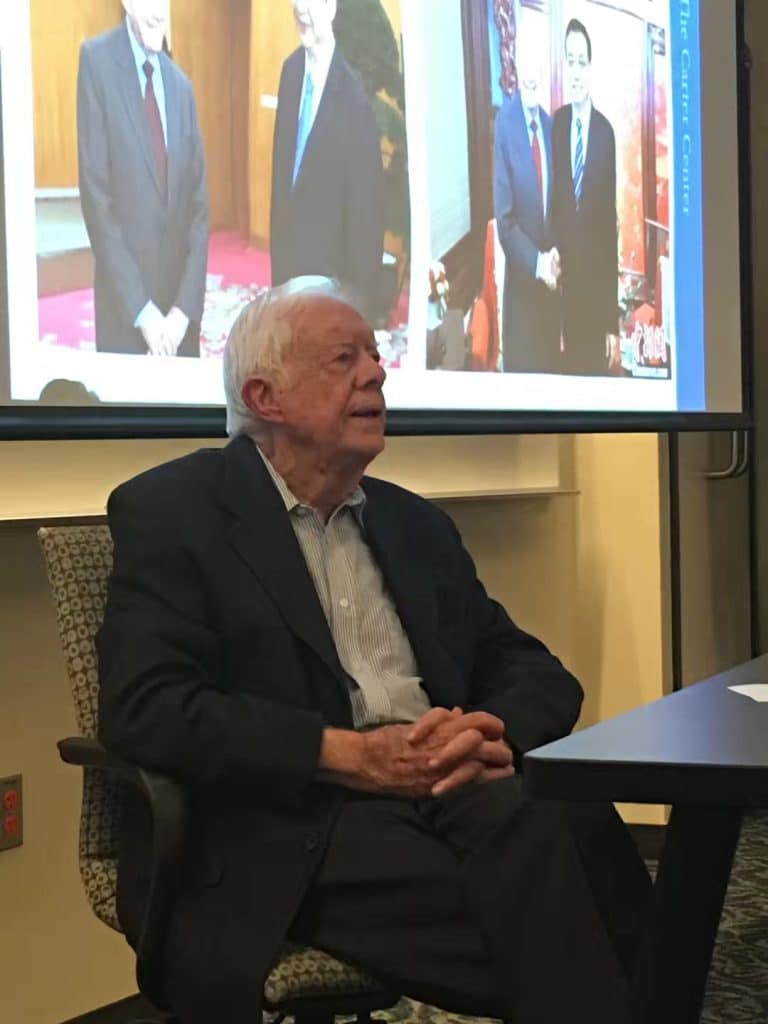
A power point slide in the background of President Carter’s lecture included photos that showed Deng and Carter’s friendship, which was a key part of negotiations to normalize relations with the PRC in 1978.

Their cooperation continued well after President Carter was forced to leave office after Reagan’s election in 1980. When he founded The Carter Center during his post-presidency, he was aware that Deng’s inclination toward openness presented an unprecedented opportunity for his NGO to work together on a common respect for human rights. Carter worked closely with Deng’s disabled son, Deng Pufang, on the Global 2000, a project launched to help disabled people overcome physical obstacles to realize their creative potential and live a productive life. The project consisted of two initiatives. The China Special Education Project equipped Chinese teachers with the skills they needed to effectively teach blind and deaf students. In addition to this basic training, teachers learned practical techniques to spot the onset of hearing impairments and mobility techniques for students with visual impairments. The other disability initiative involved the Carter Center assisting Deng Pufang’s goal to provide modern prosthetics technology to the 3 million amputees living in China.

According to President Carter, both initiatives demonstrate how much progress has been made in China-U.S. relations, and others abound if you choose to look carefully. The reality of this progress means that young students in the audience should not succumb to widespread cynicism that the relationship is worse than it has ever been. He reminded everyone that it used to be the case that both the Americans and the Chinese actively wished for the destruction of the other country. Now we have cooperated on numerous occasions to bring about unprecedented prosperity and cultural exchange. The challenge for the young generation will be to sustain this cooperation even in the face of opposition from nationalists on both sides who insist that even simple engagement is a sign of weakness.

THE CHALLENGE OF MAKE-OUR-COUNTRY-GREAT-AGAIN NATIONALISM

In analyzing China’s path over the course of his life, Carter made a bold claim—China has “greatly expanded its [positive] influence internationally and opened up freedom to its own people.” On the issue of freedom, China allows much more freedom of movement within China than it did before Deng. While there is still substantial state control of the economy, China is very far from Mao’s command economy which allowed zero opportunity for people to keep what they earned.

Yet China’s embrace of openness with the outside world has been even more striking. Almost nobody has failed to notice that China’s footprint on every continent is growing. Carter added that China’s reputation on these continents is sometimes even better than the U.S., which has squandered most of its soft power on expensive destabilizing wars. For example, Nigerian diplomats and ministers are praising China’s infrastructure investment and suggesting that their country should follow China’s example. Carter’s point is that the fact that these relations exist at all demonstrate how much things have changed since the Mao era. Before normalization, China only maintained limited contact with the outside world to demonstrate revolutionary brotherhood.

In addition to diplomatic openness, cultural openness has also enriched the opportunities of the Chinese people, Carter contended. He noted that China has more English speakers than any other country in the world, increasing opportunity for students to have meaningful interactions with English speakers around the world. Overall, he implied that China does not yet meet his personal standard for human rights, but that there needs to be a more conscious effort to acknowledge China’s improvements, and not just lecture its leaders on areas where it continues to fall short.

Of course, these improvements should not detract from the backsliding that is currently taking place in the country’s domestic politics, Carter clarified. When prompted by a student, Carter acknowledged that President Xi Jinping’s consolidation of power is an exception to the overall trend toward openness and political reform started by Deng and continued by his successors. The CCP under Xi permits less challenges on the grounds that it will diminish its legitimacy to carry out the people’s will.

Nonetheless, he also felt the need to correct exaggerated media reports, which allege that Xi is the most powerful leader since Mao. Given the authority Deng had to make decisions unencumbered by restrictions, these reports are not just wrong but dangerous, he implied. The danger for Western media is that they risk conflating China’s partial step backward on political reform into a complete reversal.

Another way Xi is strengthening the authority of the CCP is by severely restricting the operation of foreign NGO’s, who cannot help but notice rising suspicion regarding their work. A law issued by Xi’s administration last year even permits police to question foreign NGO workers and inspect their files if their work is suspected of undermining the CCP’s authority. As a result of its concern with foreign NGO’s interfere in China’s political affairs, The Carter Center has not been allowed to conduct observations of village elections even before Xi began his first term in 2012, Carter noted.

Carter’s final point was that China’s overreliance on hard power in Xinjiang and Tibet, undermines the basic human rights of the people who live there. In Xinjiang, reporters have noticed that police patrols are rounding up young men for re-education camps. Additionally, severe restrictions are placed on the practice of Islam and surveillance watches them everywhere. These three issues must be monitored because the U.S. has an obligation to promote human rights, but we must also not let this obligation prevent opportunities to engage, Carter concluded.

The primacy of bilateral engagement between the U.S. and China was a common theme throughout President Carter’s remarks. Following the era of globalization that has tied the two countries’ fates, engagement should be more fundamental to the strategic thinking of each country’s leadership, not less. President Carter therefore cautioned against the anti-China and anti-American hysteria that is currently rising in each country. He started by clarifying that blame for the deterioration in the relationship does not solely rest on American shoulders. Escalating tensions are not simply a product of an established power responding irrationally to the threat of colliding with a rising power, as suggested by one interpretation of the Thucydides Trap. Instead, we are trapped in a tit-for-tat game, where each hostile action requires an equally hostile response from the other side.

President Carter did not offer solutions for this problem, but he did offer one insight that he hoped would inspire the young students in the audience to work on solutions. That insight was that sustained people-to-people interactions between Chinese people and Americans will likely sweep away the comparable waves of xenophobic nationalism that both countries are currently experiencing. In the U.S., millions of voters pinned their hopes on Donald Trump with his promise to Make America Great Again and put America First. Likewise, in China, ordinary people frequently support the Chinese Communist Party’s efforts to move beyond its century of humiliation into a new era where China feels embowered to apply its muscular power abroad. The CCP’s current ambitions are not that distinct from Donald Trump’s pledge to Make America Great Again. They are promising an ambitious agenda—from One Belt One Road to Taiwan reunification— that will revive the former greatness of Chinese imperial power. Young Americans and Chinese who will determine the future of the relationship should not feel as if they have to abandon nationalism altogether, Carter clarified. But they do have the obligation to the health of the relationship to balance nationalism with restraint so that their leaders do not feel compelled to reflexively reject engagement and compromise. They also must seek out cross-country interactions, so that “they better understand each other and the reasons for harmony, cooperation, and mutual respect”.

THE CONSEQUENCES OF RETREATING AMERICAN INFLUENCE

On the day after this lecture, President Carter also held a Q&A session with all the Carter Center interns. In that Q&A session, he made one wise remark that clarifies the challenge as well as the opportunity in China-U.S. relations. He noted that mankind is in a transitional phase, where it reverts to its animal instincts to dominate others just as often it realizes its better angels to work together on issues that threaten global stability and existence, such as nuclear proliferation and climate change. Whether consciously or not, President Carter evoked an image originally conceived by the German philosopher, Friedrich Nietzsche, “Man is a rope stretched between animal and superman—a rope over an abyss.” In this metaphor, the animal is the impulse to adopt zero-sum strategies and return to blood and soil. On the other end of the rope, the superman cooperates on issues that are so critical to the future of humanity that they are bigger than any differences in ideology, nationality, or religious affiliation. So long as the U.S. and China are both looking in front of them, they are forced to acknowledge that they cannot let petty disagreements stand in the way of global cooperation, lest they fall into the abyss.

Th
e problem is that the U.S., the country that forged the post-war international system, does not currently appreciate the complexity of the challenges of the 21st century because it is looking backward. The Trump administration has abandoned the U.S.’s traditional commitment to global leadership. Since Trump’s election, the U.S. has withdrawn from the Paris agreement on climate change and the Trans-Pacific Partnership (TPP) on trade, abandoned UN talks on migration, neglected to prioritize nuclear proliferation issues, and cut funding on scientific research.

President Carter is likely too modest to fully take credit for this prediction, but he has been warning Americans about the decline of American superpower for more than a decade. Now, he says that it is inevitable that the U.S. will be forced to “relinquish its number one superpower title [to China]”.[3] As China is looking forward by building infrastructure and sticking to a long-term strategy, the U.S. will continue to experience the ill-considered effects of its trillion-dollar wars. Carter believes that the U.S. would be more than willing to accommodate Chinese superpower so long as it reverses some of the policies promoted by Xi and resumes the previous progress it made with respect to freedom, openness, and human rights. Subtly referring to the mistakes the U.S. made in Iraq, Carter added that China should learn from our example and not seek to impose its vision on others.

Overall, President Carter’s analysis of the emerging void of global leadership is accurate, but he neglected to mention that China is unlikely to make this progress unless the U.S. is active in global leadership. The reality is that the China’s domestic environment lacks the openness that is necessary to develop a vibrant civil society on the scale of their American counterparts. No country is capable of applying the soft power (i.e. ideas) that glues the international system together without the U.S.’s leadership.

CONCLUSION

At a fundamental level, the problem of U.S.-China relations is that China is too strong to create an alternative to the U.S.-led post-war international system without colliding with American power but too weak to preside over this system without the U.S.’s active participation. For this reason, the U.S. can neither afford to rebuff China’s efforts to garner more influence over global institutions nor can it afford to abandon its leadership role in those institutions. Representing each faction of the current Trump administration, both actions would unleash equally chaotic repercussions on the international order. The flaws in each strategy suggest that there is a need for an alternative, or third way.

The last time China changed as substantially as now was when Deng moved on from the devastation of the Mao era by initiating the Reform and Open-Up policy. Even during these changes, many American leaders were paralyzed by two inviable policy options for how the U.S. chose to conduct its relations with the Communist country. In this political environment, President Carter proposed a shift in how Americans view China. Rather than insisting on China as a sworn adversary, Carter saw the opportunity that China’s initiative to open-up its economy could promote— freedom, economic development, and cultural exchange. By normalizing relations, he altered official U.S. policy to reflect the changes that had already begun to materialize in China.

The progress China has made since normalization began in 1979 has changed the dynamics of the relationship to such an extent that it requires another leader who will bring about a similar shift in thinking. But President Carter did not fully explain what kind of shift is necessary to realign foreign policy objectives with the new reality of a rising China and its relation to the global order. He left the task of constructing a new paradigm to the next generation of young leaders.

One thing is certain though. Young leaders in both countries will be responsible for pulling Nietzsche’s rope away from reflexive nationalists toward the side of reason, perspective, toleration, and incremental progress. President Carter expressed hope these leaders will overpower the nationalists who are currently in charge, and the relationship will continue to prosper. Naturally forward looking, young people know what is at stake. They know that the abyss is far too deep to risk a misstep.

REFERENCES

[1]Carter, Jimmy. “President Carter Remembers His Experiences Dealing with China-U.S Relationship.” 14 Feb. 2018, Atlanta, GA, Emory University, Mathematics and Science Center.

[2]Ibid.

[3]Ibid.


The following summary was prepared by Vincent Palumbo-Smith, an intern at The Carter Center’s China Program for Spring 2018.

来源时间:2018/4/2   发布时间:2018/3/1

旧文章ID:15634

中美贸易战中被忽略的大象:技术转移与安全声明

作者:刘远举  来源:FT中文网

  美国宣布600亿关税的时候,我正在杭州,一个人晚上无事,去看了漫威的超级英雄电影《黑豹》。电影讲的是,多年以前,一块陨石掉到了一个原始部落。陨石上的振金金属,是一种自带科技的神奇金属,于是,原始部落的科技得以飞跃,压倒性的超越了目前地球上的任何国家。但是,原始部落在拥有高科技的同时,仍然是国王统治制度。由此也造成了电影中的一系列冲突。当然,电影的结局总是好人战胜了坏人。
  我们再来把振金故事的设定改变一下,假设振金具有这样一种性质:学习、使用这种技术的人,都会有饥饿感、会减少十年寿命。那么,当今哪个国家,承接这种振金技术的效率最高,可以一跃成为世界科技强国?显然,这就是低人权优势。这就是一个北京模式与华盛顿模式的故事。如果这个国家,像电影中那样,要去拯救世界上的劳苦大众呢?
  讲完故事,书归正传,还是回到自由贸易。
  自由贸易的第一层意思是贸易,即商品的流动,人的流动,资本的自由流动。这些流动也是技术扩散的过程。
  改革开放,特别是加入WTO后,中国制造业尤其是出口相关的制造业快速发展,中国成为世界工厂,这一经济现象的实质是技术扩散与技术承接。出口的实质是参与国际分工,国际分工背后则是技术扩散:FDI、进出口、世界工厂都是技术扩散的结果。
  承接技术转移过程,本质上是市场起作用,但中国的特殊之处则在于强大的政府主导。一般而言,政府主导是低效的,但在承接技术转移的大背景下,因为承接的是成熟的技术转移,已经过市场甄别,承接技术一方已经知道高速公路、地铁、发电厂、水坝、核电站、纺织厂、炼钢厂、乃至股份制、股票市场的技术和经济合理性,所以,不需要市场进行方向性选择,只需按既定明确的方向进行高速扩张。在这种情况下,政府强势主导的一些特点,如:集中力量办大事,产权弱约束,不追求市场效率,忽视风险,乃至低人权,就成为了承接技术扩散的优势。政府强势主导和市场化的结合,的确非常适合这一阶段的经济发展。
  在全球化体系中,技术转移的形式很多,可以是合法的知识产权转让,甚至窃取,也可以是合资建厂,外资企业技术人员跳槽,留学生等形式。值得一提的是,除了这些形式,在全球化体系中,西方国家透明、高效的学术评价体系,实际上向中国输送了学术评价功能。比如,在国外期刊上发表文章,国外的学术头衔,在中国的科研体系中是有效的,这保证了国内学术方向的正确性,学术人才评价的客观性,从而避免李森科式的意识形态学阀,也避免了当年钱学森亩产万斤这类唯长官意志的论证。从这个意义上说,中国的创新,受益于西方国家的学术体系,以及保障这种学术体系的民主、法治。
  技术创新是市场经济皇冠上的明珠。从思想自由、学术自由的角度来看,技术创新,也是自由、以及保障自由的民主与法治的结晶。所以,中国通过参与国际分工,既能发挥低人权的优势,又享受到了西方民主与法治的红利。
  自由贸易的第二层意思是自由。自由贸易,自由在前,贸易在后,先有自由,再有流动,本就有意识形态的含义。而且,自由的要素流动,会带来意识形态的扩散,导致参与贸易的各方的观念趋同。于是,自由滋生贸易,贸易促进自由,自由保障整个贸易体系的安全。
  自由贸易保证安全,还有经济层面的机制。在国际大分工的背景下,市场导向、利润导向、比较优势导向,各国必然会形成一种你中有我,我中有你的分工局面,经济上的绑定就会很紧密。比如,波音飞机的零部件由70多个国家的545家供应商生产。这就保证了整个贸易体系的安全。
  那么,如果贸易变得不那么自由呢?毫无疑问,自由贸易带来的意识形态趋同效应,没有了。这也无需多言。其次,自由贸易保证安全的经济机制,也没有了。
  传统的国际贸易理论,比较优势学说认为,国际贸易可以使一个国家在具备比较优势的领域,大幅度提高生产率。但萨缪尔森提出:通过国际贸易,一国在原本不具备比较优势的领域,也可以意外地提升了生产率。这个时候,两国间的比较优势差异不再存在,国际贸易变得没有必要。但是,原本在这个领域不具备比较优势的国家,受益了,却永损他国的利益。通常来说,按照市场原则,一般来说,一国的资本是不会投入到不具备比较优势的领域去参与国际分工的,因为没有优势,会亏本。退一步说,即便不具备比较优势的领域也会提升生产率,甚至达到和其他国家一样的水平,但这个过程必定是缓慢的。但是,当国家的产业政策、财政补贴、非市场化的手段广泛的、高强度的介入,却可在短时间内达成这个目标。最典型的例子,就是高铁。强势的刘志军以控制整个铁路市场的威力,压制德国、日本相关企业,强势的促进技术的转移和承接、以及随后的逆向工程与创新,一举使中国高铁成为世界第一。
  这种逆比较优势的行为会有什么后果呢?
  著名的科幻小说《三体》中有一个“安全声明”的概念,简单的说,就是自我剥夺飞向宇宙的能力,让别人相信自己没有危险。在现代政治理论中也有这样的安全声明,那就是所谓的“民主国家之间无战争”理论。虽然理论只是理论,但一定程度上,这仍然是一种现实的安全声明。国际贸易、全球化,使得这种声明更加可靠。
  在今天全球化、国际大分工的背景下,在市场导向、利润导向、比较优势导向下,参与国的专业化分工只能导致各自加强其原来的比较优势,也就是“自废武功”。日本没有GPS、荷兰没有CPU,美国没有光刻机、英国没有手机芯片、加拿大没有核技术。这实际上是在发表安全声明:“我始终相信世界是和平与发展的,我与世界始终不分离,不孤立,不对抗”。所以,不追求完备的工业体系,市场化的进入全球化分工,这是自由贸易之下,形成的安全声明。
  反之,如果看重、强调建设国内完整的工业体系,不是以市场导向、利润导向,而是用政策、财政补贴去扶持弱势行业,比如装备业、半导体行业中的弱势领域,计划建立完整而强大的工业体系,那么,这种方式就是在准备“我要独立于你们而生存”。
  此次贸易战成为舆论热点之后,网上有一篇文章列举了世界上其他国家掌握的,而中国还没掌握的核心技术,文章本意是想表述中国还离不开世界,但再想深一层,预示的意义深刻。首先,这种对比是不恰当的,因为是拿中国与世界相比,但是,某种程度上,这也是恰当的,因为中国对标的从来都是世界。
  再举一个例子,光刻机,是整个半导体行业的基石,甚至可以毫不夸张的说,是现代文明的基石。但是,美国人没有自己的光刻企业,而中国人热衷于发展自己的光刻技术。不管是在知乎,还是在军迷网站,光刻机都爱国青年的热点所在。
  那么,以非市场的行为参与国际贸易,这不仅是对WTO全球分工的不信任,本质上与自由贸易是冲突的。而且,更是对整个和平与发展判断的不信任,与对潜在冲突的准备。这就是不安全声明。更何况,中国还具有完全不同的意识形态、国内的民族主义甚至可以说是世界大国中,求战心情最切的人群。此外,还有孔子学院、“锐实力”的诸多行为。
  行文至此,可以总结一下了。通过有控制的参与全球贸易,中国承接了大量的技术转移,同时,国内创新体系,也受益与西方的民主与法治制度。与此同时,在政府控制下,通过非市场的方式,全面逆比较优势而行,实现赶超。同时,保持意识形态的独特性。这一切放在中国身上,显然,就是一份“不安全声明”。
  那么,站在美国及其盟友的角度,这一过程不应持续下去。所以,我们可以看到此次贸易争端中,美国人说得最多的是技术。
  这一次中美分别给出的增加关税清单中,美国主要集中在机电产品,中国主要集中在农产品。有人说,从这份清单那看,美国是一个农业国,出口农产品,而中国是一个工业国,出口的是工业品。这种解读当然是错的。美国的这份清单,一方面是保护自己国内同类产品,避免他们遭遇中国产品的竞争。另一方面,作为技术更先进的国家,高关税使得在中国生产的这类产品在美国市场缺乏竞争力,这就使得资本不会选择到中国来进行生产,再出口到美国。这就避免了因为资本流动、合资建厂等方式导致的技术转移。
  第二次世界大战之后,对于国际共产主义运动,西方有两个战略,第一是冷战,第二是自由贸易。在中国人想着以市场换技术的同时,美国人想的是,用技术换意识形态。这正好是前面所说的自由贸易的两个效应。现在,冷战成功了,而后一个战略失败了,不但失败了,而且,被两国间因为贸易产生的经济利益绑定、掩盖,并稳定下来。以至于扎克伯格可以在办公室放一本红书,不用有任何公共形象上的担心与顾虑。在上世纪60年代,这是不可想象的。整个西方恋恋不舍低人权优势产出的廉价产品,中美精英共治中国劳工的模式,让西方精英欲罢不能。这个时候,美国人选出了特朗普。特朗普或许本无意于意识形态,但是,他身边具体的政策制定者未必如此,更重要的是,一旦经济利益绑定被打破,或者减少,资本的贪婪被长远的考量压制,原来被利益掩盖的根本性的意识形态冲突就会重新冒出来,目前贸易模式所蕴含的对西方的不安全性就会被人审视,世界就不可能再回到原来的均势上。
  所以,即便短期贸易战能够得到和解,从长远来看,这种有控制、非自由的贸易模式,是不可继续下去的。

来源时间:2018/4/2   发布时间:2018/4/2

旧文章ID:15633

FT社评:如何继续与金正恩谈判?

0

作者:  来源:FT中文网

  金正恩(Kim Jong Un),在瑞士受过教育的34岁朝鲜独裁者,眼下肯定感到洋洋得意。他的核讹诈与奥运外交组合拳引发了一场竞赛,世界领导人排队等着同他会面。除了有望与美国总统唐纳德•特朗普(Donald Trump)会晤外,金正恩最大的胜利是他上周访问北京,这是他自2011年末成为最高领导人以来首次出国访问。
  在他的统治初期,北京方面宁愿与年轻的金正恩掌握实权的姑父打交道。但自从金正恩在2013年处决了他的姑父以来,中朝关系陷入了深度冻结。
  上周,在等待邀请六年多之后,金正恩终于被欢迎前往北京,受到中国国家主席习近平的隆重接待。中国显然担心在美朝和解的进程中被边缘化。
  北京等到金正恩的装甲列车安全返回朝鲜之后,才发表了经过精心剪辑的习金会报道。这些报道显然是要把金正恩描绘成一个不听话的学生,请求严肃而又慈祥的习近平原谅。这种宣传努力本身就表明了北京方面对即将登场的美朝峰会的担忧程度,以及它确保自己在不失去太多面子的情况下坐到谈判桌前的殷切程度。日本和俄罗斯领导人也在争取与金正恩会晤。
  事后看来,去年朝鲜进行的一系列火箭发射和核试验很像典型的边缘政策,目的是为谈判做准备。这种战术显而易见,但并不因此降低它的成功程度。但是,世界(特别是美国)不应该对金正恩愿意放弃核弹抱有幻想。利比亚领导人穆阿迈尔•卡扎菲(Muammer Gaddafi)和伊拉克的萨达姆•侯赛因(Saddam Hussein)的下场让他确信,他需要核武器以保证自己的生存。
  这或许意味着,不管达成什么双边协议,特朗普能够希望得到的最好结果就是削减和冻结平壤的导弹计划,从而消除其利用核武器袭击美国本土的能力。这也许是美国能够忍受的事情。但是,金正恩会索要什么作为回报?正如前总统乔治•W•布什(George W Bush)政府的美国谈判代表们所哀叹的那样,朝鲜是把同一匹马两次卖给华盛顿的专家。自封为交易大师的特朗普,是否真的准备好第三次买下同一匹老马?
  再说,即使美国能够与拥有核武的朝鲜和平共处,韩国和日本又该怎么办呢?特朗普曾表示愿意放弃美国在亚洲的最亲密盟友,让他们自找出路。绝不能发生这种情况。美国总统有责任确保这些盟友的安全,这是在无数条约中正式确立的义务。他还有一个历史性的机会来正式结束朝鲜战争,从根本上改变东北亚的地缘战略格局。
  在他上任之初,特朗普的本能是依靠中国来帮助解决朝鲜半岛危机。北京方面并不急于为他解决问题。现在局势已经改变,即使特朗普原先那个假设的逻辑没有变。
  中国仍然对任何可能达成的协议至关重要,这种协议很可能会涉及中国和美国对金正恩及其邪恶政权做出安全保证。如果能够说服北京方面投入一个真正的进程,那么朝鲜半岛无核化可能仍有希望。
  译者/何黎

来源时间:2018/4/2   发布时间:2018/4/2

旧文章ID:15632

杨毅:不要低估特朗普

作者:杨毅  来源:凤凰大参考No.416

北京战略界大讨论系列三——杨毅:不要低估特朗普

  太平洋证券第三届“一带一路”内部论坛,北京战略界讨论“竞争对手条件下的中美格局”第三章,中国国防大学战略研究所原所长、驻美使馆原武官、著名学者杨毅,前瞻美国战略调整及其撬动中国的三大选择。
  本文为杨毅将军撰文上半部分。
  特朗普在战略问题上跨越混沌期
  首先看一下,美国战略调整对世界格局带来哪些影响。
  从不同的时空概念、不同纬度、不同战略视角观察问题,会得出不同结论。我们分析美国的战略调整,要从综合战略视角看问题。
  特朗普政府2017年12月发表《国家安全战略报告》是一个重要标志,这是特朗普政府战略的“成型化”、“成人礼”。其余的战略报告,如:《国防战略报告》、《核态势报告NPR》以及特朗普的首份国情咨文,都是对《国家安全战略报告》确定的国家大战略在不同领域内的具体体现。
  特朗普上台一年多以来,推行的各项政策正在改变美国。从某种意义上讲,也在改变世界。美国政策的调整牵动世界全局,影响极大。美国战略走向是我们进行战略判断和战略决策的重要参照。
  那么,如何解读美国的《国家安全战略报告》和《国防战略报告》,以及通过这两个战略报告来判断美国的战略走向?
  《国家安全战略报告》具有特朗普特色与传统特色的综合特征,但总体上保持美国国家安全战略的连续性,特别是在基本的战略框架内(安全战略四大目标:保护美国人民、促进繁荣、以实力维护和平、推进美国影响力)。从某种意义上讲,也可以说,这两个重要战略报告的出台,标志着特朗普经过当选后在国家安全战略问题上的混沌、不确定状态,回归了美国传统战略的轨道。
  报告的出台,标志着美国新政府战略思路的整体成型化(结束碎片化)、清晰化(结束模糊混乱)、正版化(各部门声调不一致)。尽管特朗普今后还会有一些“即兴之举”,还会出一些令人难以预测的招数,但是,美国政策走向不会发生大的变化。
  “不正常”翻篇 大国竞争来临
  美国《国家安全战略报告》标志着美国战略回归“常态”,或者是回归“老常态”,包括基辛格、布热津斯基等主张的大国政治制衡理论。冷战结束后,美国“一超独霸”,福山提出的“历史的终结”理论很盛行。而当时,中国还没有过多显山露水,陶醉在冷战胜利中的美国有些得意忘形。然而,911事件触发了美国的愤怒,连续发动阿富汗和伊拉克战争,恐怖主义牵扯极大地消耗了美国的战略精力与资源。现在重新回归大国政治的传统思路,很是自然。
  从美国对安全威胁挑战的判断来看,对于“三大挑战的排序”,确定重点是“大国竞争”。这是911以来一个最明显的变化,更加突出大国竞争对美国的战略挑战,特别是中俄排在最优先地位。近年来,中国和俄罗斯整体实力与影响力上升与美国的政治战略收缩,形成一个反差。
  美国的战略报告突出特朗普提出的“美国优先”,这在两个重要报告中得以充分的体现,许多问题表述的方式都具有浓厚的“特朗普特色”。
  如果仔细研读两个报告的内容,特别是核心观点和战略举措,就可以看出,总体思路还是回归了美国传统的战略轨道。主要维护美国霸权,凭借包括军事力量在内的硬实力和软实力支撑,为美国谋求更大的利益(甚至以“损人利己的方式”)。
  战略途径选择:有原则的现实主义,重在结果,不以意识形态为标志,偏重依赖力量,尤其是硬实力。针对军事力量的运用,强调应对各种规模和各种样式的重大战争、不再消减军事力量的规模,同时要强化现代化水平。维持和增强核武库的现代化和规模、情报、太空、网络等新领域,已经公布的《国防战略报告》和《核态势报告NPR》则是充分反映了在军事领域的战略举措。
  美国《核态势报告NPR》透露出许多令人不安的信号,如:建造“哥伦比亚” 级战略核潜艇以取代“俄亥俄” 级核潜艇、开发和部署“B-21 袭击者”下一代轰炸机,替代 B-52H轰炸机和B-2A“隐形”战略轰炸机,核打击能力将大幅提高。研发潜射和水面舰艇发射的巡航核导弹、机载巡航核导弹、必要时重新进行核试验、研发低当量的核弹头,这些举措实际上就是降低了核打击门槛。
  中国需要搞好战略运筹
  我们绝不可低估特朗普政策对世界格局的冲击,特朗普并不是完全不靠谱,与美国传统政客相比,特朗普更加务实,更加“言必行、行必果”,一年多以来,他正在逐步落实他的竞选诺言。
  特朗普入主白宫后,先后不留情面地退出国际承诺(TPP、巴黎气候协定等),抛弃多边机制,唯利是图,既要面子,更要里子,更加务实,面对这样一个“混横不讲理”的美国总统,世界各国怎么办?各国如何应对?
  这就需要一个磨合过程,在这期间,有妥协,有力量重组,也有“爹死娘嫁人、各人顾个人”的混乱迷茫,整个世界都需要一个适应和磨合的过程。特朗普政策对世界的冲击是全方位的,政治、经济、安全、军事、金融等,各国都需要调整自己的思路,中国更是需要搞好战略运筹,妥善应对。

来源时间:2018/4/2   发布时间:2018/3/30

旧文章ID:15630

王湘穗:中国对美战略核心就一个字

0

作者:王湘穗  来源:凤凰大参考No.415

北京战略界大讨论系列二:国对美战略核心就一个字


  “中美两艘大船最好的相处方式是调整距离。中国对美要有合作不成,渐行渐远的打算。中国要有相应心理准备。”如果是这样,那么中国对美战略核心用一个字概括,就是“熬”。
  中美关系恐怕要熬上十年。因为这存在一个量化指标,10年之后中国有可能成为第一大经济体,而特朗普也已经下台。所以,这恐怕是中美关系非常重要的战略支点。
  做好中美不合作的应对
  美国以中国为对手的共识(包括研究界、政界、国会、军方),已经基本形成,但是行动还很难形成。因为美国现实利益分散化,包括各州、各参议员的利益均不同,因此很难形成一致行动。
  但是,不可否认,中美关系已经到了一个拐点:竞争成为主题。对这一点,中方应该有清醒认识。中国一直在讲:我们希望合作,避免对抗,但现在的情况是,美国基本不提合作。所以,中美关系拐点已经出现:求合作而不得,对抗又不可。因此可以说,当前中美就处在这样较为较尴尬的时期。但是,这又是一个基本政治现实。
  中方除了要继续寻求中美合作之外,政策以及战略的立脚点一定要找好。也就是说,要做好中美不合作的应对。
  战略走向判断是渐行渐远
  鉴于以上情况,现在中美关系需要考虑从顶层有所设计。适时调整距离,避免正面对撞。如果以前是寻求合作、管控危机,现在应该有一个基本战略走向判断:要渐行渐远。为什么?以前在美国主导下的全球体系,中国既享受到好处,又做出贡献。但在2008年金融危机后,这个体系事实上开始分裂和走向解体。
  在这种情况下,中美慢慢分开,是中国长大的必然结果。原来,中国是美国体系下的一员,但现在已经长到与美国体系并行的状态。不管是否愿意,由于中国原有产业结构、政治意向、安全等,已经成为一个“体”,这个“体”是美国的那个“体”容纳不下的。
  在这种情况下,中美两艘大船最好的方式是调整距离。
  中国对美要有合作不成,渐行渐远的打算。这应该成为我们基本战略选择,中国要有相应心理准备。
  核心就一个字 熬
  如果是这样,那么中国对美的战略核心用一个字概括,核心就是熬。从策略上而言,很多事情要拖。比如朝鲜问题,就是要有定力慢慢拖,到最后还是按照不能生乱的路线走,这对于中国有好处。很多的事情也是一样,包括刚刚讲到的台湾问题,原则上不能让对方碰触底线,但是很多的事情上,根本不会按照中方的预想节奏走,最后恐怕就得熬。
  中美关系恐怕要熬上十年差不多。因为存在一个量化指标,10年之后,中国有可能成为第一大经济体,而特朗普也已经下台。所以,这恐怕是中美关系非常重要的战略支点。
  形成币缘联系 不会大破局
  笔者于去年写了一本书,《币缘论》。在以前,地缘政治、地缘冲突的概念为人熟知,并大量存在。尤其在工业时代,市场的占领、资源地的占领,都是国家主要利益形态的代表。就像黑格尔讲的,“国家是走在地上的神”。而在今天,国家更多的利益形态,则是表现到货币金融上。
  美国的国家利益形态,或称国家生态,大量都表现在货币经营上。然后,围绕核心国际货币体系,形成国际关系。在这一点上,中国的货币国际化,实际就是在建立自己的“币缘圈”。
  虽然目前很多往外走的金融企业并没有这样的政治和思想自觉,但今后是需要的,因为国际大国都是这样建立起来的。
  从历史上看,葡萄牙人和西班牙人从美国拉回白银,随后荷兰人独立与之打了30年战争,大多现在的银行股份公司,都是那时候建立起来的。即用西班牙人的钱,建立起了荷兰的金融机构。随后,英荷战争打起时,英国遇到工业革命,其股权市场上68%的股票控制是由荷兰人掌握,因此荷兰人又分享了英国工业革命的成果;同时,英国在美国投资超过50%,英国人又分享给了美国。
  因此,金融和货币在一定时候可以成为大国合作的纽带。中美一定要激烈博弈一段时期,到最后,很可能又通过币缘联系,形成了某种利益关系,而导致不会大破局,而且还可能在建立新的秩序下,靠币缘政治作为纽带。
  编者注:
  特朗普2017年12月19日发表《国家安全战略报告》称:中俄“修正主义大国”是美国战略竞争对手。为配合该报告,2018年1月19日美国国防部发布《国防新战略》,不仅提倡全方位国家战略竞争,而且第一次把中、俄、伊朗、朝鲜和恐怖主义列为对美国同等重要威胁。
  1月30日,特朗普在2018年度国会国情咨文中延续了上述两个报告思路,即把中俄继续定义为竞争对手关系,第一次使用“rivals”(对手)形容中俄,比过去“competitiors”(竞争者)更进一步,而且强调中国对美国构成的挑战是全方位的,包括美国的利益、经济和价值观。
  这种形势对中、美、俄、欧多边关系乃至世界格局、“一带一路”倡议,以及金融企业对美中长期业务,都形成巨大挑战。因此,中方需要对此进行深入分析和慎重评估,为下一阶段企业对外业务提供良好的战略分析支撑。

来源时间:2018/4/2   发布时间:2018/3/28

旧文章ID:15629

国会和特朗普打破对台政策微妙平衡

0

作者:特德•盖伦•卡彭特  来源:中美聚焦

  美国国会和特朗普总统最近采取的行动使美国对台政策关键而微妙的平衡面临被打破危险。他们的行动激怒了中国,使华盛顿与北京之间本已令人不安的紧张加剧。在引起东亚的一场大危机之前,美国官员必须重新评估他们的行动方针。
  3月1日,参议院通过了《台湾旅行法》,该法案已于今年1月在众议院获得通过。这一措施宣告美国的政策应是允许各级官员访问台湾与同行会晤,并允许台湾高级官员入美与美国的官员会面。值得注意的是,《台湾旅行法》特别鼓励“内阁级国家安全官员”的互动。
  这项措施没有强迫行政部门改变政策,但它显然是国会的意愿,希望美国与台湾政府建立更紧的尤其是防务上的关系。由于参议院通过此项立法时没有反对票,因此国会的立场得以强化。至少,《台湾旅行法》为更实质性的双边关系打下基础,并推动特朗普政府朝这一方向前进。
  中国政府显然担心美国即将出现重大的政策转变。北京强烈抗议《台湾旅行法》的通过。外交部发言人华春莹说,中方对该法案“强烈不满”,它“严重违反”了两国间达成的谅解。
  虽然只是非正式的克制而非法律要求,但自从1979年将正式外交关系从台北转向北京,华盛顿的政策向来是只授权低级(通常是经济)决策官员与台湾同行互动。总统、国务卿、国防部长等显赫官员始终小心翼翼避免与台湾领导人会面,以免激怒中国。
  现在还不确定这种谨慎会不会消失,但其可能性肯定是存在的。这项措施要成为法律,特朗普总统原本不必签字,但他还是签署了该法案,这表明他对法案内容的认同。此举加剧了北京方面的不满。
  中国领导人已经有理由因为特朗普的对台立场而感到不安。当选总统特朗普与台湾总统蔡英文2016年12月广受争议的电话交谈曾经造成巨大轰动。自从1979年承认中华人民共和国是中国合法政府以来,历任当选总统都未与台湾领导人进行过互动。中国官员担心,新一届政府可能放弃“一个中国”政策,这是美中关系的基础。2017年2月特朗普向习近平主席保证华盛顿将继续全面奉行“一个中国”政策,使这些担忧得以缓解。而《台湾旅行法》的通过几乎肯定会让中国再次提高警惕。
  多年来,《台湾旅行法》的部分支持者一直主张与这个岛屿建立更紧密的双边关系,特别是安全合作。他们认为华盛顿必须最大限度地支持一个充满活力的民主朋友。有些人,如前美国驻联合国大使约翰·博尔顿,甚至敦促华盛顿考虑进一步给予台北正式的外交承认,并将目前驻冲绳的美军重新部署到台湾。
  然而,这些狂热的支持者一直没有足够人数或影响力推动《台湾旅行法》这类措施获得通过。过去一年来北京对台湾的行动似乎是催化剂,使愿意站出来表示美国会给这个陷入困境的岛屿更大支持的议员人数大为增加。
  对于蔡英文和支持独立的民进党在2016年1月的台湾大选中获胜,中国用严厉而不妥协的举措作出回应,这让美国整个政治和政策圈的不安加剧。在马英九比较好说话的国民党执掌台湾的八年中,北京软化了自身政策,认为培养台湾与大陆间稳健的经济关系会逐渐让台湾人愿意接受政治上的统一。民进党在大选中压倒性的胜利表明这种想法只是一厢情愿。
  中国官员随后重新加紧活动,使台湾所剩无几的建交国(主要是非洲和拉美小国)与台北断交并转向北京。2016年12月下旬,圣多美和普林西比与台北断交,2017年6月巴拿马也与台北断交。在台湾日益缩短的政治盟友名册上的其他国家,显然也列入了北京的目标名单。
  更让人担忧的是中国的军事行动。2017年中国在台湾周边地区进行了16次军事演习,相比之下2016年只有8次,2008年至2016年期间甚至更少。2017年12月中国军机在台湾北部海岸附近演习,今年1月北京的海空军演习达到高潮,当时包括航空母舰在内的一支中国舰队穿越了台湾海峡。中国领导人强调这些行动的重要意义。中国高级别官员刘军川放话说,“两岸综合实力对比将越来越悬殊,我对台在战略上将形成全面压倒性优势”。
  这种行为令台湾在美国国会及其他地方的朋友感到不安和愤怒。北京对台压力的不断增大,甚至让持谨慎态度的人也接受这样的观点,即华盛顿需要发出支持台湾的明确信号。《台湾旅行法》就是在这种气氛下出台的。
  在某种程度上,《台湾旅行法》是可被理解的反应。但它不明智地破坏了一种极其微妙的局面。美国向来是在创造性的模糊中行使对华与对台政策。华盛顿与台湾保持广泛的经济关系,并向台北出售“防御”武器,尽管美国没有正式承认台湾的政治地位。而最近这次强烈的对台倾斜意味着重大的政策变化。即使特朗普政府不充分实施《台湾旅行法》,将来的政府现在也已经得到了国会的授权与鼓励。
  中国领导人对这种政策变化不会有好的反应。事实上,来自中国国家媒体的言论令人担忧。《环球时报》和半官方分析人士甚至建议北京或许对《台湾旅行法》作出“军事性”回应。其他媒体则不祥地警告说,这项法案加大了战争危险。此类言论也许只是虚张声势,但却表明中国精英在台湾问题上的强烈情感和决心。当美国把玩“一个中国”政策的时候,它其实正在玩非常危险的游戏。

来源时间:2018/4/2   发布时间:2018/3/27

旧文章ID:15627